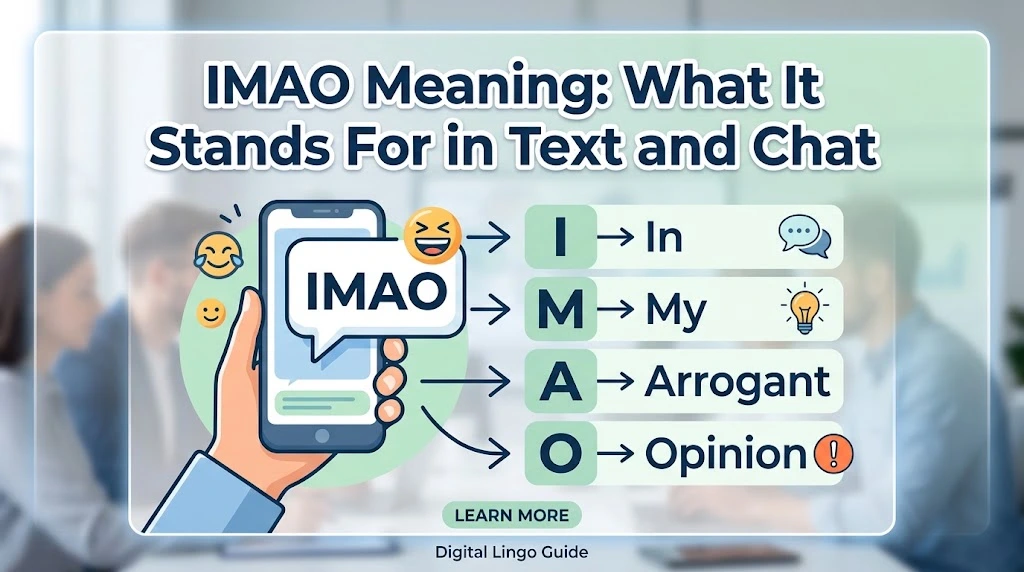
Have you seen IMAO in a text message, social media comment, or online conversation? This abbreviation can be confusing because it looks almost identical to LMAO, a popular expression for laughter. However, IMAO has its own meaning in internet slang.
IMAO usually stands for “In My Arrogant Opinion.” People use it to introduce a personal opinion with humor, sarcasm, or exaggerated confidence. It is a playful alternative to expressions such as IMO (In My Opinion) and IMHO (In My Humble Opinion).
For example, someone might write, “IMAO, this is the best movie ever made.” They may be expressing a genuine preference while joking about how strongly they feel. The exact tone depends on the conversation and the relationship between the people communicating.
There is another important detail: IMAO can sometimes be a typing mistake for LMAO because lowercase “l” and uppercase “I” look similar in many fonts. Understanding the surrounding message helps you determine which meaning makes sense.
Quick Answer
IMAO means “In My Arrogant Opinion.” It is informal internet slang used to express an opinion with playful confidence, irony, or sarcasm. In some messages, it may simply be a typo for LMAO, meaning “Laughing My Ass Off.”
TL;DR
- Full form: In My Arrogant Opinion.
- Main meaning: A humorous or self-aware way to share an opinion.
- Tone: Often playful, confident, ironic, or sarcastic.
- Similar abbreviation: IMO means In My Opinion.
- Another alternative: IMHO means In My Humble Opinion.
- Common confusion: IMAO may be a typo for LMAO, an expression of laughter.
What Does IMAO Mean in Text?
In texting, IMAO usually introduces someone’s personal viewpoint. It suggests that the person is expressing an opinion without pretending to be completely neutral or humble.
For example, imagine two friends discussing their favorite pizza toppings. One says, “IMAO, pineapple belongs on every pizza.” The abbreviation adds a humorous, slightly overconfident tone to an otherwise ordinary preference.
IMAO is not as widely recognized as IMO, IMHO, or LMAO. Because of this, readers may interpret it differently depending on the conversation.
Read More : WYS Meaning in Text: What It Means and How to Use It
What Does “In My Arrogant Opinion” Actually Mean?
The phrase playfully admits that the speaker might sound arrogant. Rather than claiming to be an authority, the person often uses exaggerated confidence for comic effect.
Consider these examples:
- “IMAO, my playlist is better than every radio station.”
- “IMAO, that was the best episode of the entire series.”
- “IMAO, homemade burgers beat restaurant burgers.”
In each example, the writer shares a personal preference while adding a touch of humor. The statement does not necessarily mean the person is genuinely arrogant.
Can IMAO Have Another Meaning?
Yes. Context matters because IMAO resembles LMAO, and the two abbreviations serve different purposes.
If someone writes, “That video was hilarious imao,” they might have intended to type LMAO. If they write, “IMAO, this restaurant is overrated,” the opinion-based meaning is more likely.
The spelling alone cannot always reveal the writer’s intention. Read the complete sentence before deciding what the abbreviation means.
How Is IMAO Different From IMO, IMHO, and LMAO?
These abbreviations look similar, but their meanings and purposes differ. Knowing the difference helps you understand text messages and avoid confusing an opinion with a reaction to something funny.
| Abbreviation | Full Form | Main Purpose |
| IMAO | In My Arrogant Opinion | Shares an opinion with ironic confidence |
| IMO | In My Opinion | Introduces a personal viewpoint |
| IMHO | In My Humble Opinion | Presents an opinion with a modest tone |
| LMAO | Laughing My Ass Off | Expresses strong amusement |
| LOL | Laughing Out Loud | Shows laughter or a lighthearted reaction |
IMAO is a playful twist on IMHO, while IMO is a more straightforward way to express an opinion. LMAO and LOL, on the other hand, are mainly reactions to something funny.
IMAO vs. IMO
IMO is much more direct. It tells the reader that a statement represents the writer’s personal view.
- IMO: “This is the best restaurant in town.”
- IMAO: “IMAO, this is the best restaurant in the entire country.”
The second example adds exaggerated confidence. However, the intended humor depends on the writer’s tone and the surrounding conversation.
IMAO vs. IMHO
IMHO stands for “In My Humble Opinion.” It often softens a statement or signals that the writer recognizes other people may disagree.
IMAO replaces “humble” with “arrogant,” creating a humorous contrast. It can make a strong opinion sound self-aware rather than entirely serious.
IMAO vs. LMAO
This is the most important distinction because the abbreviations differ by only one letter.
- “IMAO, coffee is better than tea.” — The writer is expressing an opinion.
- “That coffee prank was hilarious, LMAO!” — The writer is reacting to something funny.
- “That coffee prank was hilarious, imao!” — The writer may have mistyped LMAO.
If the message describes a funny event, LMAO may be what the sender intended. If it introduces a viewpoint, IMAO is more likely to be intentional.
Where Is IMAO Used Online?
IMAO belongs to informal internet language. It can appear in text messages, discussion forums, comments, and other online conversations where people express personal opinions.
Text Messages and Group Chats
Friends may use IMAO when discussing entertainment, food, hobbies, or everyday disagreements.
For example:
Friend 1: Which superhero movie is the best?
Friend 2: IMAO, the first one is still unbeatable.
Here, the abbreviation gives the answer a playful, confident tone.
Social Media Comments
On platforms such as Instagram and TikTok, people may encounter IMAO in comments or casual discussions.
For example:
“IMAO, this outfit looks better than the expensive designer version.”
The writer is sharing a personal judgment. The phrase may sound humorous, bold, or slightly sarcastic depending on the discussion.
These are illustrative examples, not claims that IMAO is a leading abbreviation on either platform.
Online Forums and Gaming Chats
Internet forums have a documented history of using IMAO to introduce opinions, including opinions expressed during disagreements. The abbreviation appeared in Usenet discussions in 1989, long before today’s social media platforms became popular.
In gaming communities, someone might use it while discussing strategies, characters, or game updates.
For example:
“IMAO, the older version of this game was much better.”
The meaning remains the same: the person is presenting a viewpoint, often with a humorous or assertive edge.
What Is the Origin and History of IMAO?
IMAO has a documented history in early online discussion groups. Its development shows how internet users adapted existing abbreviations to express different tones.
The Early Usenet Connection
One early documented use appeared in a May 1989 Usenet discussion about the band the Grateful Dead. The writer, David Vinayak Wallace, used IMAO to introduce his assessment of different periods of the band’s history.
He also explained the abbreviation in a postscript, making its meaning clear to readers. Historical records show additional uses during 1989, often in discussions involving disagreements or strong opinions.
This evidence establishes that IMAO was being used by 1989. It does not prove that this was the first time anyone ever used it.
How IMAO Relates to IMHO
IMAO developed as a twist on IMHO, which stands for “In My Humble Opinion.” Instead of presenting an opinion with humility, IMAO jokingly acknowledges the opposite.
That contrast gives the abbreviation its distinctive tone. It can communicate confidence while also making fun of the speaker’s own certainty.
Over time, IMAO appeared in a wider range of online conversations, although it did not become as widely established as IMHO.
Why Its Meaning Can Be Confusing Today
Modern digital communication creates another source of confusion: the visual similarity between lowercase “l” and uppercase “I.”
In many sans-serif fonts, the two characters look almost identical. Consequently, a person who intends to type LMAO may accidentally write IMAO instead.
This is why you should not assume every occurrence represents the phrase “In My Arrogant Opinion.”
What Tone Does IMAO Convey?
The meaning of IMAO is relatively clear, but its emotional tone can vary. The writer may be joking, expressing confidence, or making a sarcastic point.
Humor and Self-Awareness
IMAO often works as a joke about the speaker’s own confidence.
For example:
“IMAO, I could win every cooking competition with my grilled cheese.”
The statement sounds deliberately overconfident. The writer may simply be teasing friends rather than making a serious claim.
Sarcasm and Strong Opinions
Sometimes, IMAO introduces a strong opinion that challenges what other people believe.
For example:
“IMAO, the sequel was better than the original.”
The writer might be making an ordinary comparison, or the statement might be intended to provoke a friendly debate.
The abbreviation alone does not establish whether the writer is being sarcastic. The rest of the message matters.
Can IMAO Sound Rude?
Yes, it can sound rude in certain situations, especially when paired with insulting language or dismissive comments.
For example:
“IMAO, anyone who likes that movie has terrible taste.”
Although the abbreviation may be intended humorously, the sentence could offend someone who enjoys the movie.
If you want to avoid misunderstandings, consider the audience and the subject before using IMAO. A joke between close friends may not work as well in a serious discussion.
How Do You Use IMAO Correctly?
You can use IMAO when you want to share an opinion while adding a playful or exaggerated tone. It is best suited to casual communication rather than formal writing.
Simple Examples of IMAO in Sentences
Here are some examples showing how the abbreviation works in different conversations.
| Example | Intended Meaning or Tone |
| “IMAO, pizza is the perfect food.” | Playful confidence |
| “IMAO, that was the best concert ever.” | Strong personal preference |
| “IMAO, this game needs a better ending.” | Opinion with a casual tone |
| “IMAO, my team never makes mistakes.” | Likely humorous exaggeration |
| “IMAO, the book was better than the movie.” | Personal judgment |
These examples demonstrate possible uses rather than fixed rules. The same abbreviation may sound different depending on the people involved.
Where Should You Avoid Using IMAO?
Avoid using IMAO in professional documents, formal emails, academic writing, or serious business discussions unless the context clearly welcomes informal language.
Many readers may not recognize the abbreviation. Others may interpret “arrogant” literally rather than as a joke.
In these situations, writing “in my opinion” or stating your viewpoint directly is usually clearer.
How Should You Reply When Someone Uses IMAO?
Your response depends on what the other person means and how they express it.
When They Share an Opinion
If the sender uses IMAO to introduce a viewpoint, you can agree, disagree, or ask a question.
Examples:
- “Fair point!”
- “I actually agree with you.”
- “Interesting take. I see it differently.”
- “Why do you think that?”
You do not need to use another abbreviation in response. A natural reply is usually enough.
When They May Have Meant LMAO
If IMAO appears after a joke or funny video, the sender may have mistyped LMAO.
You can simply respond to the joke. If the intended meaning genuinely matters, ask, “Did you mean LMAO?”
There is usually no need to correct a harmless typing mistake unless it causes confusion.
Common Misunderstandings About IMAO
Several misconceptions can make this abbreviation harder to interpret.
- IMAO always means laughter: Not necessarily. Its established acronym meaning is “In My Arrogant Opinion,” although it may be a typo for LMAO.
- IMAO and IMO are identical: Both can introduce opinions, but IMAO adds a humorous or self-aware suggestion of arrogance.
- Everyone understands IMAO: Many readers may not recognize it, particularly if they are more familiar with common abbreviations such as LOL and LMAO.
- Using IMAO means someone is genuinely arrogant: Not automatically. The phrase often uses irony or self-deprecating humor.
- IMAO has one fixed tone: Its tone depends on the sentence, the conversation, and the relationship between the participants.
The safest way to interpret IMAO is to consider the complete message rather than relying on the abbreviation alone.
FAQs
1. What does IMAO stand for in texting?
IMAO stands for “In My Arrogant Opinion.” It is an informal abbreviation used to express a viewpoint with humor, irony, or exaggerated confidence.
2. Does IMAO mean the same as LMAO?
No. IMAO means “In My Arrogant Opinion,” while LMAO means “Laughing My Ass Off.” However, IMAO can appear when someone accidentally types a capital I instead of a lowercase L.
3. Is IMAO rude or offensive?
IMAO is not inherently offensive. It can sound sarcastic or arrogant depending on the statement, but it is often used jokingly among friends.
4. What is the difference between IMAO and IMHO?
IMAO means “In My Arrogant Opinion,” while IMHO means “In My Humble Opinion.” IMAO often adds playful confidence, whereas IMHO can soften an opinion.
5. Can I use IMAO in professional messages?
It is generally better to avoid IMAO in formal or professional communication. Some readers may not understand the abbreviation or may interpret its wording literally.
6. How can I tell whether someone meant IMAO or LMAO?
Look at the surrounding sentence. If the person is introducing an opinion, IMAO is more likely; if they are reacting to something funny, they may have intended LMAO.
Conclusion
The IMAO meaning in internet slang is “In My Arrogant Opinion.” It allows people to share personal views with a humorous, confident, or sarcastic tone. Its meaning is closely related to IMHO, but the wording deliberately replaces humility with arrogance.
However, IMAO can also be a typing mistake for LMAO, especially because the letters look similar in some fonts. Context is the best way to distinguish the two meanings.
When you encounter IMAO in a text, comment, or online discussion, look at what the person is saying. Understanding the surrounding conversation will help you interpret the abbreviation correctly and respond naturally.



1 thought on “IMAO Meaning: What It Stands For in Text and Chat”