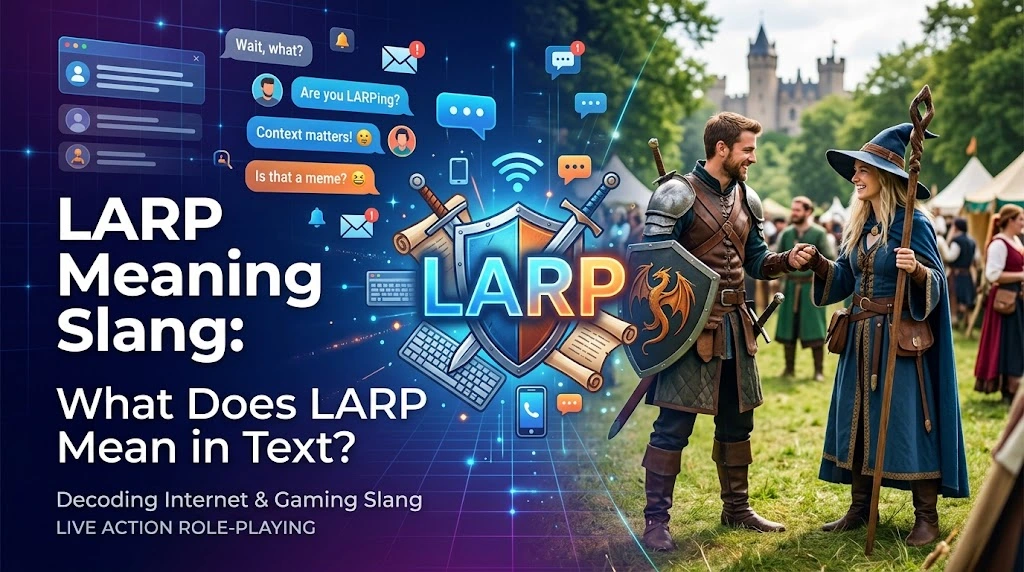
If you have seen LARP meaning slang in a text, social media post, gaming community, or online conversation, you may wonder what LARP actually means. In most casual contexts, LARP stands for Live Action Role-Playing. It describes an activity where people physically act out fictional characters, stories, or scenarios instead of simply playing a traditional tabletop or video game. However, in internet slang, LARP can also have a broader meaning.
When someone says that a person is LARPing, they may mean that the person is pretending, acting, or presenting themselves online as something they are not. For example, someone might claim to be extremely wealthy, powerful, experienced, or knowledgeable when others believe the claim is not genuine. In this sense, LARP slang can be used in a teasing, critical, or humorous way.
Understanding the LARP definition, LARP abbreviation, and LARP online meaning can help you interpret conversations more accurately. The exact meaning depends on the context of LARP, the community using it, and the tone of the conversation. Whether you encounter LARP in texting, LARP on social media, gaming discussions, or everyday internet communication, recognizing the surrounding words usually makes the intended meaning clear.
Quick Answer
In American slang, larp meaning slang usually refers to pretending, role-playing, or presenting yourself as something you aren’t. It can also refer to genuine live-action role-playing games, where people act as fictional characters for entertainment.
TL;DR
- LARP originally means live-action role-playing.
- Gamers use LARP for physical, character-based role-playing events.
- Online slang can mean pretending or performing a fake identity.
- “Stop LARPing” often means “stop pretending.”
- The slang can be playful, critical, or humorous.
- Context determines whether LARP is positive or insulting.
Read More:Huzz Meaning: What It Means in Slang Today
What Does LARP Mean?
LARP is an acronym for live-action role-playing. Unlike traditional tabletop games, participants physically act as characters within a fictional setting.
For example, someone might dress as a medieval knight and interact with other players. The activity can involve costumes, stories, battles, quests, and improvised dialogue.
LARP as a Gaming Term
Traditional LARP involves people creating or joining an imagined world. Players usually have characters, goals, rules, and some type of shared story.
Common LARP settings include:
- Medieval fantasy kingdoms
- Historical-inspired adventures
- Science-fiction worlds
- Horror and supernatural stories
- Modern mystery scenarios
The exact rules vary greatly between groups. Some events focus heavily on storytelling, while others emphasize costumes, combat, or character development.
LARP as Internet Slang
Online, LARP can have a different meaning. People may use it as a verb when accusing someone of pretending to be something they aren’t.
For instance:
“He keeps talking like he’s a millionaire, but he’s LARPing.”
Here, LARPing doesn’t mean participating in an actual role-playing game. It means the speaker thinks the person is performing a fictional identity.
Where Did LARP Come From?
LARP developed from the broader history of role-playing games and fantasy entertainment. Its modern form grew during the late twentieth century.
Role-playing games became increasingly popular in the United States during the 1970s. Tabletop games allowed players to create characters and participate in imaginary adventures.
From Tabletop Games to Live Events
Eventually, some players wanted to physically act out their characters. Instead of sitting around a table, participants could move through a real environment.
That helped create live-action forms of role-playing.
The term live-action role-playing became associated with these activities. Over time, LARP communities developed different rules and traditions.
The Growth of Fantasy Culture
Fantasy literature, gaming, costumes, and fan communities also helped LARP grow.
In the United States, conventions and organized gaming communities gave players places to meet. As the internet expanded, LARP communities gained new ways to communicate and organize events.
Today, LARP can describe both a hobby and a broader internet metaphor.
What Does LARP Mean on the Internet?
Internet users often use LARP differently from traditional players. Online, it can describe someone who appears to be acting out a fictional persona.
The word often carries a skeptical tone in this setting. Someone may use it because they believe another person is exaggerating their identity or lifestyle.
Common Online Meanings
Depending on context, LARP can suggest:
- Pretending to have experiences you don’t actually have
- Acting like an expert without relevant experience
- Creating a fictional online persona
- Exaggerating wealth, status, power, or influence
- Performing an identity for attention
However, the accusation isn’t automatically true. LARP is often someone’s opinion about another person’s behavior.
Why Context Matters
Consider this sentence:
“I’m LARPing as a detective for this game.”
That describes intentional role-playing.
Now consider:
“He’s LARPing as a business expert online.”
The second sentence suggests the speaker believes the person is pretending.
The same word can therefore describe harmless entertainment or criticism.
Why Do People Say “Stop LARPing”?
“Stop LARPing” is a common way to tell someone to stop pretending. The phrase often appears during online disagreements.
For example, someone might claim extensive military experience. Another user could respond, “Stop LARPing.”
What the Speaker Usually Means
In slang, the phrase may communicate:
- “Stop pretending to be something you’re not.”
- “You’re exaggerating your experience.”
- “You’re acting out a fake persona.”
- “Your story doesn’t seem believable.”
The exact accusation depends on the conversation.
Is “Stop LARPing” an Insult?
It can be.
The phrase often challenges someone’s honesty or authenticity. However, people sometimes use it jokingly between friends.
Therefore, tone matters. A playful comment and a serious accusation can use exactly the same words.
LARP Meaning in American Culture
LARP has a special place in American gaming and internet culture. The United States has a large history of tabletop gaming, fantasy fandom, conventions, and online communities.
As these communities grew, LARP became familiar to people who had never attended an event.
From Hobby to Slang
Internet communities often turn specialized words into everyday slang.
LARP followed this pattern. A term describing physical role-playing eventually became a metaphor for performing an identity.
This change is common in informal online language. Communities borrow words and give them broader meanings.
What LARP Can Signal
When Americans use LARP as slang, they may be discussing authenticity.
The speaker may be questioning whether someone genuinely lives according to the identity they display.
That doesn’t prove the accusation is correct. It simply explains what the slang usually communicates.
LARP Meaning in Social Media
Social media has helped expand the slang use of LARP. People can create carefully managed versions of themselves online.
As a result, discussions about authenticity often use words connected with performance and role-playing.
Common Social Media Contexts
You may encounter LARP in conversations about:
- Wealth and luxury lifestyles
- Fitness and body-building culture
- Business and entrepreneurship
- Gaming and technology
- Military or survival interests
- Online personalities
For example, a person may call someone’s expensive-looking lifestyle “a LARP” if they believe the presentation is exaggerated.
Why the Term Fits
Social media often involves some level of self-presentation. People choose photos, captions, usernames, and stories that show particular parts of their lives.
LARP can describe the gap between presentation and perceived reality.
Still, outsiders can’t always know someone’s complete circumstances. Therefore, the slang can sometimes be used unfairly.
LARP Meaning in Gaming
The original meaning remains important. In gaming communities, LARP usually refers to an actual activity rather than fake behavior.
Participants may spend hours or days staying in character.
What Happens During a LARP?
A LARP event can include:
• Players creating fictional characters with specific goals
• Costumes that help establish the imagined setting
• Improvised conversations between different characters
• Physical activities based on the game’s rules
• Storylines that change through player decisions
• Groups working together to create an immersive experience
The experience can range from casual gatherings to large organized events.
Why People Enjoy LARP
For many participants, LARP combines creativity with social interaction.
It can also provide an unusual way to explore storytelling. Players temporarily step into roles that differ from everyday life.
That is very different from using LARP as an accusation online.
Is LARP the Same as Role-Playing?
LARP and role-playing are closely connected, but they aren’t identical terms.
Role-playing is a broad concept. LARP is one specific form where participants physically act out their characters.
The Main Difference
Tabletop role-playing usually happens around a table. Players describe actions while a game system guides the experience.
LARP brings those actions into a physical environment. Participants generally move, speak, and interact as their characters.
| Context | Meaning of LARP | Typical Association | Tone |
| Gaming event | Live-action role-playing | Costumes and characters | Usually positive |
| Online argument | Pretending or performing | Fake identity claims | Often critical |
| Social media | Exaggerated persona | Lifestyle presentation | Can be mocking |
| Casual conversation | Acting or pretending | Playful role-play | Depends on context |
| Fantasy community | Organized role-playing | Storytelling and immersion | Usually neutral |
The important point is that LARP doesn’t automatically mean fake. Its original gaming meaning is genuine role-playing.
What Does LARPing Mean?
“LARPing” is the present-participle form of LARP. In gaming, it means participating in a live-action role-playing activity.
In internet slang, it can mean pretending or acting out a particular identity.
Examples of LARPing
Someone might say:
“We’re LARPing as medieval villagers this weekend.”
That’s literal LARPing.
Another person might say:
“He’s LARPing as a Wall Street expert.”
That’s slang. The speaker believes the person is performing an identity.
LARPing Isn’t Always Deliberate Deception
Sometimes people use the term loosely.
A person might exaggerate for humor without seriously trying to deceive anyone. Another person might genuinely believe the character they’re playing.
Therefore, the word alone doesn’t establish someone’s intentions.
The Psychological Meaning Behind LARP Slang
LARP slang often connects with ideas about identity and authenticity. People naturally change how they communicate in different settings.
For example, someone might act more formal at work and more relaxed with friends. That doesn’t necessarily mean either personality is fake.
Read More : Helonium Meaning: Symbolism, History, and Modern Use
Why People Use Performance Language
Words like LARP can make an abstract idea easier to describe.
Instead of saying:
“I believe this person’s online identity doesn’t match reality.”
Someone can simply say:
“They’re LARPing.”
The slang is shorter and more expressive.
Feelings Associated With the Term
Depending on context, LARP can suggest:
- Humor
- Skepticism
- Embarrassment
- Playfulness
- Distrust
- Criticism
The emotional meaning comes mainly from the speaker’s intent.
LARP in Tattoos, Fashion, and Pop Culture
The original LARP concept can also appear in physical forms of self-expression.
Some people enjoy fantasy costumes, medieval clothing, fictional characters, weapons designed for games, or themed accessories.
LARP-Inspired Style
LARP events often use visual elements to establish fictional worlds.
These may include:
• Medieval-style clothing and armor
• Fantasy-inspired weapons and shields
• Character-specific symbols and accessories
• Wizard, knight, ranger, or royal designs
• Elaborate costumes for immersive events
These items don’t automatically carry a deeper symbolic meaning. Their meaning depends on the fictional setting.
Pop Culture Influence
Fantasy movies, television, games, conventions, and online communities have made role-playing more familiar.
Consequently, someone who has never attended a LARP event may still understand the basic idea.
The slang meaning developed alongside this wider cultural familiarity.
LARP Meaning in Different Communities
LARP doesn’t have one universal meaning. Different communities can use the term differently.
Understanding the community can make the intended meaning much clearer.
Gaming Communities
Among gamers, LARP often has its original meaning.
Someone saying “I have a LARP this weekend” may simply be talking about attending an organized event.
Online Communities
In general internet conversations, LARP may have a more critical meaning.
A person might describe another user’s behavior as LARPing when they believe the person is playing a role online.
Political and Ideological Discussions
LARP can also appear in political or ideological arguments. In those settings, people sometimes use it to accuse others of performing an identity or adopting beliefs they don’t genuinely hold.
The accusation is subjective and shouldn’t automatically be treated as an established fact.
Is LARPing Always Negative?
No. The meaning depends heavily on context.
Literal LARPing is normally a recreational activity. Participants intentionally play fictional characters, so pretending is part of the experience.
Positive or Neutral Uses
LARP can describe:
- Creative storytelling
- Fantasy entertainment
- Character development
- Community activities
- Improvised performance
- Themed social events
These uses don’t imply dishonesty.
Negative Uses
Online slang can become negative when someone uses LARP to question another person’s authenticity.
For example, “He’s LARPing” can suggest the person is falsely presenting themselves as wealthy, experienced, powerful, or knowledgeable.
That interpretation comes from the speaker, not from the word itself.
Common Misunderstandings About LARP
Because LARP has two major meanings, confusion is common.
The biggest mistake is assuming that every use refers to fake behavior.
LARP Doesn’t Always Mean “Fake”
In gaming, LARP is a legitimate form of role-playing.
Participants know they’re playing characters. The fictional nature of the activity is part of the entertainment.
LARP Doesn’t Prove Someone Is Lying
Online, calling someone a LARPer is an accusation or judgment about their behavior.
It doesn’t independently prove that person’s claims are false.
This distinction matters because internet slang can turn assumptions into labels very quickly.
How LARP Meaning Has Changed Over Time
The meaning of LARP has expanded significantly.
Its original use centered on live-action role-playing. Later, online communities began using it metaphorically.
Earlier Meaning
The traditional meaning described people physically participating in fictional scenarios.
The focus was on games, storytelling, costumes, and character interaction.
Modern Slang Meaning
Today, LARP can describe someone who appears to be performing an identity in real life or online.
This newer meaning is especially common in informal digital conversations.
The change shows how internet communities often transform specialized vocabulary into broader slang.
LARP vs. Pretending, Role-Playing, and Cosplay
These terms overlap, but each has a different focus.
Pretending is the broadest concept. It can involve acting as though something is true.
Role-playing means taking on a character or role. It can happen in games, education, theater, or everyday situations.
Cosplay usually involves dressing as a specific fictional character.
LARP combines role-playing with physical, live interaction inside an organized fictional setting.
Why the Distinction Matters
Someone wearing a superhero costume isn’t automatically LARPing.
Likewise, someone pretending to be a character at home isn’t necessarily participating in a LARP.
The setting, rules, interaction, and purpose help determine the correct term.
Conclusion
The larp meaning slang has grown beyond its original gaming roots. Today, LARP can describe genuine live-action role-playing or, in online slang, someone who seems to be pretending or performing an identity.In the United States, context is especially important. A person discussing a fantasy event probably means the traditional hobby, while someone saying “stop LARPing” is usually questioning another person’s authenticity.Ultimately, LARP is a useful example of how language changes with culture and technology. Its meaning can shift from imaginative play to online commentary, so the surrounding conversation usually tells you what the speaker really means.
FAQs
What does LARP mean in slang?
LARP in slang usually means pretending or acting like someone you aren’t. Online, “LARPing” can describe someone who appears to be performing a particular identity.
What does LARP stand for?
LARP stands for live-action role-playing. It describes games where participants physically act as fictional characters.
What does “stop LARPing” mean?
“Stop LARPing” usually means “stop pretending” or “stop acting like something you’re not.” The phrase can be serious, sarcastic, or playful depending on context.
Is LARPing an insult?
It can be when used as internet slang. However, LARPing is also the normal name for a recreational role-playing activity, so the word isn’t inherently insulting.
Is LARP the same as cosplay?
No. Cosplay mainly focuses on dressing as a character, while LARP involves actively playing a character within a live scenario. Some LARP participants may also use cosplay-style costumes.
Why do people say someone is LARPing online?
People usually say this when they believe someone’s online persona doesn’t match reality. The statement reflects the speaker’s interpretation and isn’t necessarily proof that the person is being dishonest.


2 thoughts on “LARP Meaning Slang: What Does LARP Mean in Text?”