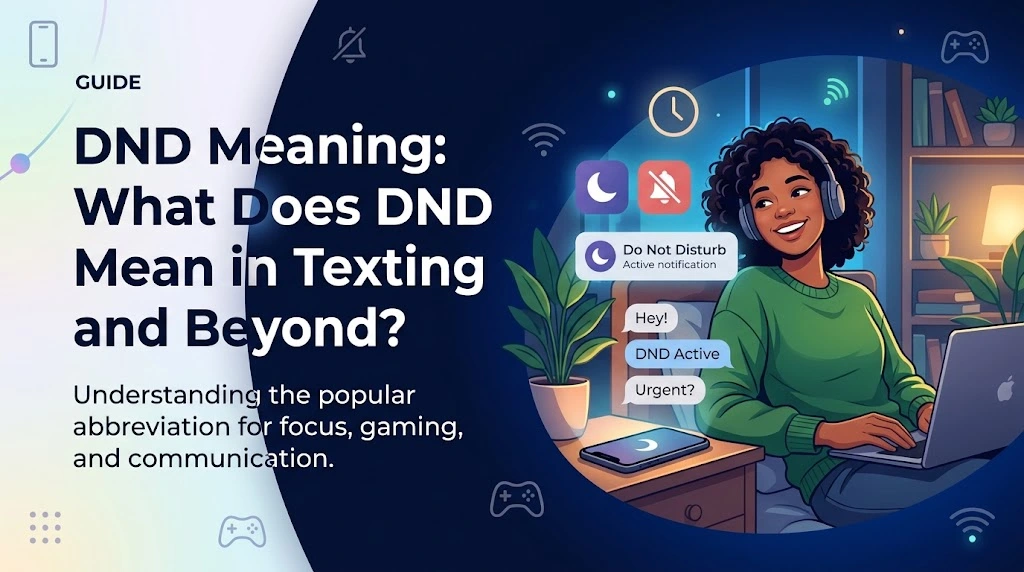
Have you ever received a text message saying “DND” and wondered what it means? The DND meaning can change depending on the situation, but it most commonly stands for Do Not Disturb. People use this popular texting abbreviation when they want some quiet time, avoid interruptions, or let others know they are unavailable. You may see DND in texting, social media messages, online chats, gaming conversations, and smartphone settings.
Understanding what DND means can help you communicate more clearly and avoid misunderstandings. For example, when a friend says, “My phone is on DND,” they usually mean their device is silencing notifications, incoming calls, and other alerts. In everyday conversations, someone might also use DND slang to request privacy or uninterrupted time.
However, DND meaning in text is not the only interpretation. In gaming, DND can refer to Dungeons & Dragons, a famous tabletop role-playing game. Its meaning may also depend on the conversation, the platform, and the person’s intentions.
Quick Answer
DND meaning usually refers to “Do Not Disturb” in American texting and everyday digital communication. It signals a need for privacy, quiet, or fewer interruptions. In gaming communities, however, DND can mean Dungeons & Dragons, a fantasy role-playing game built around creativity and teamwork.
TL;DR
- DND usually stands for Do Not Disturb in texting and messaging.
- It can indicate privacy, rest, concentration, or temporary unavailability.
- Smartphones use DND settings to manage calls and notifications.
- DND can also refer to Dungeons & Dragons in gaming communities.
- Its meaning depends on the conversation and surrounding context.
What Does DND Mean in Everyday Communication?
DND is a short form that communicates a simple message: someone doesn’t want interruptions. In the United States, you’ll commonly encounter it in text messages, phone settings, and online conversations.
The Main Meanings of DND
The abbreviation has two especially common meanings in everyday American life.
Do Not Disturb: People use this meaning when they want quiet time, fewer notifications, or uninterrupted work.
Dungeons & Dragons: Gamers use DND or D&D when discussing the fantasy role-playing game, its characters, and its adventures.
For example, “I’m on DND until tomorrow” probably refers to notification settings or personal boundaries. However, “Our DND campaign starts tonight” clearly points toward gaming.
Why Context Matters
Abbreviations often have several meanings because different communities use the same letters. Therefore, the surrounding words provide the strongest clue.
Consider these examples:
- “My phone is on DND.” This refers to silenced notifications.
- “Please leave me on DND tonight.” This suggests a desire for quiet.
- “I made a new DND character.” This refers to a role-playing game.
- “We’re hosting a DND session.” This usually describes a gaming gathering.
When the meaning remains unclear, asking a simple follow-up question is better than guessing.
What Is the History Behind DND?
Although DND looks like modern internet slang, its main meanings developed through different cultural histories. One grew from everyday requests for privacy, while the other emerged from American tabletop gaming.
The Origins of Do Not Disturb
The phrase “Do Not Disturb” existed long before smartphones. People used it to communicate that they wanted privacy or didn’t wish to receive visitors.
For example, hotels commonly placed door hangers outside guest rooms. These signs told housekeeping and other staff to avoid entering for routine tasks.
Over time, the phrase moved into offices, personal communication, and electronic devices. As phones became central to daily life, DND gained a new role in managing interruptions.
The Origins of Dungeons & Dragons
Dungeons & Dragons began in the United States during the 1970s. Gary Gygax and Dave Arneson helped develop the original game, which was published in 1974.
It brought fantasy storytelling, character creation, and dice-based decisions together in a shared activity. Players could explore imaginary worlds rather than follow one fixed storyline.
The game eventually became a major part of tabletop gaming culture. Today, its influence extends into online communities, video games, entertainment, and fantasy storytelling.
What Does DND Mean in American Culture?
In the United States, DND connects with two familiar cultural ideas: personal boundaries and shared imagination. Its meaning depends on whether someone is talking about everyday life or gaming.
DND and Personal Boundaries
Americans often use DND to communicate that they’re temporarily unavailable. This can help people protect their time without explaining every detail.
For example, an employee might activate DND during an important meeting. A student might use it while studying for an exam.
In these situations, DND can represent:
- Respect for personal time and privacy.
- A desire to concentrate without interruptions.
- Clear communication about temporary availability.
- A boundary between work and relaxation.
However, the abbreviation doesn’t automatically indicate frustration or anger. Often, it simply means someone needs uninterrupted time.
Read More: 30 Other Ways to Say “Keep Up The Great Work” (With Examples)
DND and American Gaming Culture
Dungeons & Dragons has developed a lasting place in American hobby culture. Friends gather around tables, create characters, and build stories together.
The game also encourages imagination and cooperative problem-solving. Players often work together rather than compete against one another.
As online communities have grown, DND discussions have spread across gaming forums, livestreams, and social platforms. Consequently, the abbreviation can represent a shared interest and a sense of belonging.
What Does DND Mean on Phones and Social Media?
DND appears across digital platforms because people need quick ways to manage their availability. However, its exact function depends on the device or application.
DND on Smartphones
On many phones, Do Not Disturb is a setting that silences or limits interruptions. Depending on the settings, calls, alerts, and notifications may be muted while selected people or apps remain allowed.
For example, someone might schedule DND overnight to avoid notification sounds while sleeping. Another person might enable it during work hours.
Keep in mind that DND doesn’t necessarily block messages from arriving. It often changes how notifications appear or sound instead.
DND in Messaging Apps
In online chats, DND may describe a person’s status rather than a technical setting. Someone might write it in a profile, group chat, or direct message.
Common examples include:
- “DND right now” to signal temporary unavailability.
- “On DND” to explain delayed replies.
- “DND until Monday” to communicate a longer break.
- “Phone on DND” to describe a device setting.
On gaming platforms, however, DND might refer to a hobby or gaming session. Read the conversation before interpreting the abbreviation.
What Does DND Symbolize Emotionally?
DND isn’t a traditional visual symbol with one fixed meaning. Nevertheless, people can associate it with emotional ideas such as privacy, independence, peace, and control over their time.
Privacy and Independence
When someone uses DND, they may be protecting their personal space. The action can communicate that their attention isn’t available to everyone at every moment.
This doesn’t necessarily mean they dislike other people. Instead, they may want to decide when to respond.
For many people, that choice represents independence and control over daily routines.
Peace and Concentration
DND can also represent a quieter environment. Fewer interruptions may help someone focus on reading, studying, relaxing, or spending time with family.
The emotional meaning depends on the situation. A person enabling DND before bed may associate it with rest, while someone using it during work may associate it with concentration.
Creativity and Belonging
In gaming contexts, DND can suggest imagination, friendship, and adventure. Players often build characters and stories that reflect their interests and creative choices.
For some fans, the game becomes a social activity that strengthens friendships. It may also provide a welcoming space for storytelling and collaboration.
What Does DND Mean Spiritually or Across Cultures?
DND doesn’t have one established spiritual meaning across religions or cultures. Its modern use is mainly practical, although people may connect quiet time with personal reflection.
Quiet Time and Reflection
Some people associate periods without notifications with mindfulness or spiritual practice. Turning off alerts can create space for prayer, meditation, reading, or reflection.
However, this is a personal association rather than a universal spiritual interpretation of DND. The abbreviation itself doesn’t represent a specific ancient religious symbol.
DND and Fantasy Traditions
Dungeons & Dragons draws on fantasy storytelling, mythical creatures, and imagined worlds. Its adventures may include dragons, magical objects, heroic quests, and fictional religious systems.
These elements resemble themes found in many kinds of mythology and literature. Still, the game’s fictional traditions shouldn’t be treated as identical to actual religious beliefs.
Understanding this distinction helps readers appreciate fantasy symbolism without confusing it with historical spiritual practices.
How Is DND Used in Modern Life?
Today, DND can be a practical digital setting, a casual expression, or a reference to a favorite hobby. Its use reflects how technology and entertainment influence everyday communication.
DND in Texting and Relationships
People sometimes use DND to explain why they won’t reply immediately. In relationships, this can help establish expectations about communication.
For example, someone might tell a partner they need a quiet evening. They may still care about the relationship while choosing to take a break from their phone.
However, DND alone doesn’t reveal someone’s feelings. It’s better to consider the wider conversation and respect clearly communicated boundaries.
DND in Gaming Communities
Gaming communities use DND to discuss campaigns, characters, rules, and upcoming sessions. Fans may also display dice, fantasy artwork, or character illustrations to show their interest.
Common examples include:
- Sharing character designs with other players.
- Scheduling a weekend role-playing session.
- Discussing a fictional world or adventure.
- Posting artwork inspired by fantasy creatures.
Unlike the phone setting, this meaning emphasizes creativity and shared entertainment.
DND in Profiles and Personal Statuses
A person might include “DND” in a social media bio or status message. In that setting, it may communicate limited availability or an interest in gaming.
The meaning becomes clearer when other details provide context. A fantasy character image suggests gaming, while a status about sleeping or studying suggests Do Not Disturb.
DND Examples and Their Meanings
The easiest way to understand DND is to compare how people use it in different situations. The same abbreviation can communicate very different ideas.
| Example | Likely Meaning | Context |
| “I’m on DND tonight.” | Do Not Disturb | Personal time |
| “My phone was on DND.” | Do Not Disturb | Smartphone settings |
| “DND session at 7 PM.” | Dungeons & Dragons | Gaming plans |
| “Creating my first DND character.” | Dungeons & Dragons | Character design |
| “DND until my exam ends.” | Do Not Disturb | Studying |
How to Interpret DND Correctly
Start by identifying the topic of the conversation. If the person mentions calls, notifications, work, or sleep, Do Not Disturb is the likely meaning.
If they discuss dice, fantasy characters, campaigns, or quests, they probably mean Dungeons & Dragons. When neither interpretation fits, ask what they mean rather than assuming.
What Are Common Misunderstandings About DND?
DND is simple, but its meaning can be misunderstood when people interpret it without context. A few common mistakes are worth avoiding.
Does DND Mean Someone Is Ignoring You?
Not necessarily. Someone might have silenced notifications because they’re busy, resting, or concentrating.
Although DND can be used to limit communication, it doesn’t prove that someone is deliberately avoiding you. Consider their explanation and normal communication habits before drawing conclusions.
Does DND Block All Calls and Messages?
No, not always. Many DND settings silence notifications rather than prevent messages from arriving.
Some devices and apps also allow selected contacts or repeated calls through. The precise behavior depends on the settings and platform.
Is DND Always About Gaming?
No. In everyday texting, Do Not Disturb is usually the intended meaning.
Gaming becomes the stronger interpretation when the conversation mentions characters, campaigns, dice, or fantasy adventures.
Is DND Rude?
The abbreviation isn’t inherently rude. Its tone depends on how someone uses it and the expectations between the people communicating.
A polite message explaining that someone needs quiet time may sound considerate. A blunt instruction could feel less friendly, even when the underlying boundary is reasonable.
How Has the Meaning of DND Changed Over Time?
DND has expanded from a straightforward request for privacy into a widely recognized digital abbreviation. Meanwhile, its gaming meaning developed through a separate cultural path.
From Signs to Smartphone Settings
Originally, “Do Not Disturb” was a practical message used in physical spaces. Door signs and similar notices helped people communicate when interruptions weren’t welcome.
Later, phones and other electronic devices adopted the phrase. As notification systems developed, DND became a convenient way to manage digital interruptions.
From Tabletop Games to Online Communities
Dungeons & Dragons began as a tabletop role-playing game in the 1970s. Over subsequent decades, it attracted new players and influenced many forms of fantasy entertainment.
Today, online communities make it easier to organize sessions and share stories. The abbreviation therefore carries both a long-standing hobby meaning and a modern digital presence.
Why Both Meanings Remain Relevant
The two meanings serve different needs, so neither replaces the other. One helps people manage interruptions, while the other identifies a shared game.
As messaging habits and entertainment continue to evolve, context remains the best way to understand DND.
FAQs
What Does DND Stand for in Text Messages?
DND usually stands for “Do Not Disturb” in text messages. It means someone may be unavailable or has limited notifications to avoid interruptions.
What Does DND Mean on an iPhone?
On an iPhone, DND refers to the Do Not Disturb option within Apple’s Focus features. It lets users silence or manage notifications according to their preferences.
What Does DND Mean on Snapchat or Instagram?
On social media, DND usually means someone doesn’t want to be disturbed or expects delayed replies. However, it can refer to Dungeons & Dragons when the conversation involves gaming.
What Does DND Mean in Gaming?
In gaming, DND commonly refers to Dungeons & Dragons. It’s a tabletop role-playing game where players create characters and cooperate in imaginative adventures.
Does DND Mean Do Not Disturb or Dungeons & Dragons?
Both meanings are correct. Do Not Disturb is common in everyday messaging, while Dungeons & Dragons is common among fantasy and role-playing game fans.
How Should You Reply When Someone Says They’re on DND?
A respectful response could be, “No problem, message me when you’re free.” This acknowledges their need for quiet without demanding an immediate reply.
Conclusion
DND usually means Do Not Disturb in texting, smartphones, and everyday American communication. It can represent privacy, concentration, rest, and personal boundaries. In gaming communities, however, it often refers to Dungeons & Dragons, a game centered on imagination and teamwork.
The most important clue is context. Messages about notifications and availability suggest one meaning, while conversations about fantasy adventures suggest the other.
Next time you encounter DND, look at the surrounding words before deciding what it means. A little context can make even unfamiliar abbreviations easy to understand.