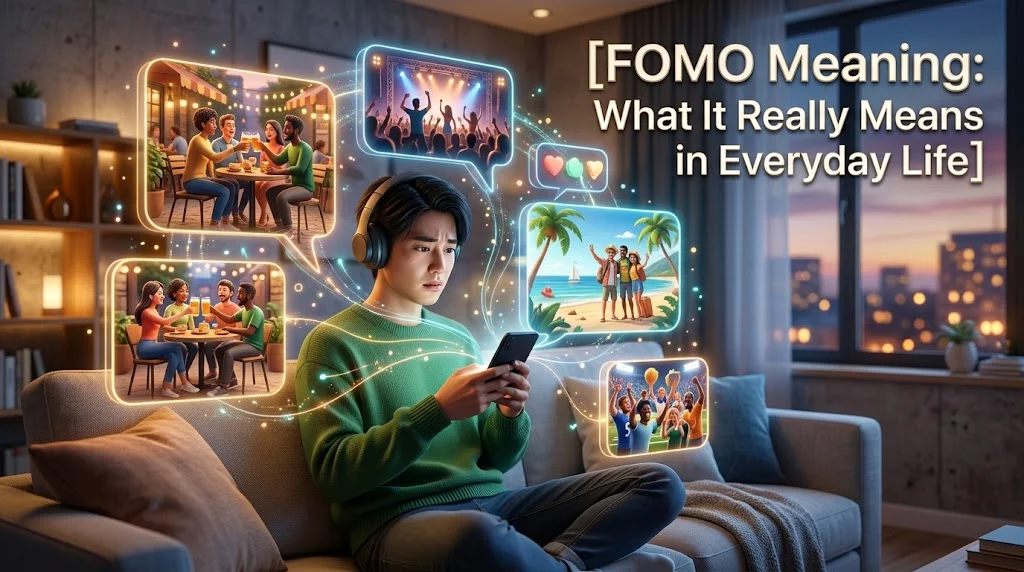
FOMO Meaning refers to the fear of missing out, a feeling that you might miss an exciting, valuable, or important experience that other people are enjoying. The term FOMO commonly appears in social media, text messages, online conversations, and everyday discussions. When someone sees friends attending a party, traveling, buying something popular, or enjoying an event without them, they may experience FOMO.
This fear of missing out can make people feel anxious, left out, curious, or pressured to participate. For example, you might keep checking Instagram, TikTok, or Snapchat because you want to know what everyone else is doing. FOMO can also influence social decisions, shopping habits, relationships, and even work-related choices.
People often use FOMO casually in sentences such as, “I have serious FOMO after seeing their vacation pictures.” The expression can describe both a temporary feeling and a broader pattern of social comparison.Understanding what FOMO means, where the abbreviation comes from, and how people use it can help you recognize the term in online slang, texting language, and everyday American English.
Quick Answer
FOMO Meaning in the USA is the feeling that you’re missing an exciting, valuable, or socially important experience that others are enjoying. More broadly, it describes anxiety or concern about being left out of rewarding opportunities.
TL;DR
- FOMO stands for fear of missing out.
- It often appears when people compare their experiences with others.
- Social media has made FOMO especially visible in American culture.
- FOMO can influence parties, travel, shopping, and social decisions.
- The phrase became widely popular during the digital and social-media era.
- Today, people also use FOMO casually and humorously.
Read More:CM Meaning: What Does CM Mean in Text?
What Does FOMO Mean?
FOMO is an abbreviation for fear of missing out. It describes concern that other people are enjoying something worthwhile while you’re not participating.
The phrase can describe serious feelings or a simple everyday reaction. For example, you might say, “I have FOMO seeing everyone at the concert.”
How People Use FOMO
In everyday American English, FOMO commonly describes situations involving:
• Social events you decided not to attend
• Trips or experiences other people are enjoying
• Limited-time sales or special offers
• Popular trends spreading through social media
• Career or networking opportunities you might miss
The meaning depends heavily on context. Sometimes FOMO expresses genuine worry, while other times it simply means, “That looks fun, and I wish I were there.”
FOMO as a Modern Expression
Unlike an ancient symbol, FOMO is a modern cultural concept. Its symbolism comes from the emotions and social behaviors connected with participation, exclusion, comparison, and opportunity.
Therefore, its “symbolism” is less about a physical object and more about a recognizable human experience.
What Is the Origin of FOMO?
The basic feeling behind FOMO is much older than the phrase itself. People have long compared their lives with others and worried about missing opportunities.
However, the modern abbreviation developed alongside digital communication and social networking.
Early Use of the Phrase
The term FOMO is widely associated with marketing researcher Dan Herman, who discussed the concept in the late 1990s. The expression later gained broader attention through technology and social-media culture.
In the 2000s, blogs, social networks, smartphones, and constant online updates made the idea easier to describe.
Why the Phrase Became Popular
The internet changed how people experienced other people’s activities.
Previously, you might hear about a party after it happened. Today, you can watch photographs, videos, stories, and live updates while the event is happening.
That constant visibility gives FOMO a powerful modern setting.
Why Is FOMO So Common in America?
American culture places strong value on experiences, opportunities, social participation, and personal choice. As a result, missing an opportunity can sometimes feel more significant.
Social media has added another layer. People can constantly see carefully selected moments from friends, celebrities, influencers, and businesses.
American Examples
FOMO can appear when someone:
• Sees friends attending an event without them
• Watches coworkers receive opportunities they missed
• Notices everyone discussing a popular new experience
• Finds a product advertised as available briefly
• Sees vacation photos while staying home
These situations don’t automatically create serious distress. Often, Americans use the term casually in ordinary conversation.
FOMO and the Idea of Opportunity
The concept can also involve opportunity rather than entertainment.
Someone might worry about missing a professional event, networking opportunity, educational program, or important social gathering.
In this sense, FOMO can represent the desire to remain connected and informed.
What Does FOMO Symbolize in American Culture?
FOMO often symbolizes social connection, opportunity, comparison, and the desire to participate.
It can reveal how strongly modern communication connects personal experiences with other people’s visible lives.
| Context | Meaning in the USA | Common Association | Notes |
| Social events | Worry about being left out | Parties and gatherings | Often used casually |
| Social media | Comparison with others | Photos and updates | Visibility can intensify the feeling |
| Shopping | Fear of missing an opportunity | Limited-time deals | Marketing often uses urgency |
| Travel | Desire to experience more | Vacations and destinations | Online images can influence expectations |
| Work | Concern about missed opportunities | Networking and career events | Participation may feel important |
Connection and Belonging
At its core, FOMO can represent the human desire to belong. People naturally pay attention to what their social groups are doing.
However, modern technology makes those comparisons much easier to notice.
Participation and Identity
FOMO can also connect with identity. Someone may think, “People like me are doing this, so maybe I should join.”
That doesn’t necessarily mean the person lacks confidence. It can simply reflect the importance of social belonging.
How Does Social Media Create FOMO?
Social media is one of the clearest modern environments for FOMO. Platforms allow users to see what others are doing almost instantly.
However, online posts rarely show every part of someone’s life.
The Highlight-Reel Effect
People commonly share celebrations, vacations, achievements, meals, parties, and memorable moments.
They usually don’t post every boring or difficult moment.
As a result, viewers may compare their ordinary day with someone else’s carefully selected highlights.
Digital Comparison
FOMO can emerge from seeing:
• Friends attending events you skipped
• People traveling to places you haven’t visited
• Groups celebrating without you
• New trends spreading among your peers
• Professional achievements appearing in your feed
The important point is that online visibility doesn’t always represent someone’s complete reality.
Stories and Real-Time Updates
Real-time posts can make FOMO feel immediate.
A photograph from yesterday may feel distant. A live update from an event happening right now can create a stronger sense of missing something.
What Is the Psychological Meaning of FOMO?
FOMO is closely connected with comparison, belonging, uncertainty, and perceived opportunity.
It doesn’t automatically indicate a psychological disorder. In everyday language, FOMO usually describes a temporary emotional reaction.
Comparison With Others
People naturally compare their experiences with those around them.
For example, someone might enjoy a quiet weekend until they see several friends posting about a major festival.
Suddenly, their own weekend may seem less exciting.
Desire for Belonging
FOMO can also reflect a wish to remain part of a group.
When people believe others are sharing an experience without them, they may worry about missing conversations, memories, or relationships.
Anticipation and Uncertainty
Sometimes FOMO happens before an event.
You might wonder whether you should attend a gathering because you don’t know what you’ll miss.
That uncertainty can make the decision harder.
Is FOMO Always Negative?
No. The phrase usually describes an uncomfortable feeling, but the behavior connected with it isn’t always harmful.
FOMO can sometimes encourage people to participate in experiences they genuinely value.
Positive Side
Someone might experience FOMO and decide to:
• Reconnect with old friends
• Attend a community event
• Try a new hobby
• Explore an unfamiliar city
• Join an interesting social activity
In these situations, the feeling can simply draw attention to an opportunity.
When FOMO Becomes Unhelpful
Problems can arise when someone repeatedly makes choices only because others are participating.
For example, a person might spend money, cancel plans, or lose sleep simply to avoid feeling left out.
The phrase itself doesn’t determine whether a choice is healthy or unhealthy. Context matters.
What Does FOMO Mean in Texting and Social Media?
In texting, FOMO usually has a casual meaning.
Someone might write, “I’m getting major FOMO,” after seeing friends at a restaurant or event.
Common Digital Examples
You may see expressions such as:
• “FOMO is real.”
• “I have serious FOMO.”
• “Don’t give me FOMO.”
• “This picture is giving me FOMO.”
• “I skipped it, and now I have FOMO.”
The tone is often playful rather than deeply emotional.
FOMO as Internet Slang
FOMO belongs to a broader group of digital expressions that became common through online communication.
Unlike many short-lived slang terms, however, FOMO entered mainstream everyday English.
People can use it in texts, conversations, workplace discussions, advertising, and journalism.
What Is the Difference Between FOMO and JOMO?
JOMO means the joy of missing out. It describes feeling comfortable or happy about not participating.
The two expressions represent different reactions to the same basic situation.
FOMO vs. JOMO
| Expression | Basic Feeling | Example |
| FOMO | Concern about missing something | “Everyone went without me.” |
| JOMO | Satisfaction with staying out | “I’m happy I stayed home.” |
Why JOMO Became Popular
As people became more aware of constant digital comparison, some began celebrating quiet time and intentional disconnection.
JOMO represents the idea that missing an event isn’t necessarily a problem.
Instead, staying home can sometimes be a deliberate choice.
How Is FOMO Used in Marketing?
Businesses sometimes use urgency to encourage people to act quickly.
Messages about limited availability, temporary offers, or exclusive access can make an opportunity feel more urgent.
Common FOMO Signals
Marketing may emphasize:
• Limited-time availability
• Small quantities
• Exclusive access
• Special events
• Temporary discounts
• Early participation
These messages can create a sense that waiting might mean missing an opportunity.
FOMO and Consumer Culture
In the United States, FOMO can appear in shopping, entertainment, travel, and event promotion.
However, the phrase doesn’t automatically mean that marketing tactics are deceptive. The effect depends on whether the opportunity and its limits are accurately represented.
What Are the Cross-Cultural Meanings of FOMO?
The specific abbreviation FOMO comes from modern English-language digital culture. However, the underlying feeling isn’t limited to the United States.
People in many societies experience concern about exclusion or missed opportunities.
A Universal Human Experience
Across cultures, people may care about:
• Belonging to social groups
• Maintaining friendships and relationships
• Sharing important experiences
• Discovering new opportunities
• Understanding what their communities value
The expression may differ between languages, but the basic social feeling can be widely recognized.
Cultural Differences Matter
However, the way FOMO appears can vary.
Some cultures place stronger emphasis on group participation, while others may emphasize personal independence. Therefore, the same situation can carry different social meanings.
What Does FOMO Symbolize Emotionally?
Emotionally, FOMO can symbolize curiosity, uncertainty, social connection, anticipation, or exclusion.
The exact emotion depends on why someone feels they are missing out.
Common Emotional Associations
FOMO may involve:
• Curiosity about what others are experiencing
• Anxiety about being excluded
• Excitement about a possible opportunity
• Regret about a previous decision
• Desire for greater social connection
• Uncertainty about whether to participate
These feelings can overlap.
Someone may feel excited about an event while simultaneously worrying about missing it.
FOMO and Personal Identity
FOMO can also reveal what someone values.
For one person, missing a concert may matter greatly. For another, missing a quiet weekend at home may feel completely unimportant.
That difference shows how personal values shape the experience.
How Is FOMO Used in Modern Culture?
FOMO now appears across American digital and everyday culture.
The expression can describe social activities, entertainment, travel, shopping, work, and even food.
FOMO in Social Media
People often use FOMO when reacting to photos, videos, stories, and announcements.
The phrase can function as both a genuine statement and a humorous reaction.
FOMO in Tattoos and Design
FOMO isn’t traditionally a visual symbol like a rose, snake, or moon.
However, someone could use the word or abbreviation in a tattoo to represent a personal experience with social pressure, digital culture, or a particular period of life.
FOMO in Everyday Conversation
The abbreviation has become easy to understand for many English speakers.
Someone might say, “I don’t want FOMO,” meaning they don’t want to regret skipping an experience.
Another person might say, “No FOMO here,” showing that they’re perfectly happy with their decision.
Common Misunderstandings About FOMO
FOMO is sometimes misunderstood as simply wanting everything.
That isn’t quite accurate.
FOMO Isn’t Just Jealousy
Jealousy usually involves concern about losing something or someone.
FOMO focuses more specifically on missing an experience, opportunity, or social moment.
The two feelings can overlap, but they aren’t identical.
FOMO Doesn’t Always Mean Serious Anxiety
People frequently use FOMO as casual slang.
For example, someone may jokingly say they have FOMO because their friends ordered pizza without them.
Therefore, context is important when interpreting the phrase.
FOMO Isn’t Only About Social Media
Social media makes FOMO highly visible, but the feeling can exist offline.
A person can experience FOMO after hearing about a party, conference, trip, concert, or family gathering.
How Has the Meaning of FOMO Changed?
The underlying feeling is old, but the modern expression developed alongside digital culture.
As communication became faster, people gained more opportunities to observe what others were doing.
Before Smartphones
People could still feel left out before the internet.
However, information about social activities usually traveled more slowly.
You might hear about an event from a friend or see photographs later.
During the Social-Media Era
Social networks changed that experience.
People could watch events unfold through photographs, updates, and messages.
As a result, FOMO became a useful word for describing an increasingly visible form of social comparison.
FOMO Today
Today, the expression has expanded beyond social networking.
Americans use it for entertainment, travel, shopping, work, hobbies, and ordinary social situations.
Its meaning remains centered on the same basic idea: not wanting to miss something that seems valuable or meaningful.
Conclusion
FOMO Meaning is simply the fear of missing out. It describes the feeling that other people are experiencing something enjoyable, valuable, or important while you are missing it. The term is especially common in social media, texting, and casual online conversations.FOMO can appear when people compare their lives with others, see exciting events online, or worry about being excluded. For example, someone might feel FOMO after seeing friends having fun without them. The expression can also describe pressure to attend an event, purchase a product, join a trend, or stay connected online.Although FOMO is often used casually, understanding its context helps you recognize whether someone is talking about social pressure, missing an opportunity, or simply wanting to participate. In everyday conversation, “I have FOMO” usually means “I’m worried I’m missing out on something.”
FAQS
What does FOMO mean?
FOMO means “fear of missing out.” It describes the feeling that you may be missing an enjoyable, important, or valuable experience that other people are having.
What does FOMO mean in texting?
In texting, FOMO has the same meaning: fear of missing out. Someone might say, “I have FOMO,” when they wish they could join an activity or event.
Is FOMO slang?
Yes. FOMO is widely used as an informal expression and internet slang term, particularly in social media, texting, and casual conversations.
What is an example of FOMO?
An example is seeing your friends posting pictures from a party you didn’t attend and thinking, “I wish I had gone.” That feeling is FOMO.
Why do people experience FOMO?
People may experience FOMO because of social comparison, curiosity, exclusion, or the feeling that others are enjoying opportunities they are missing.
Is FOMO always negative?
Not necessarily. FOMO can sometimes encourage someone to participate in social activities or try something new. However, excessive FOMO can create unnecessary pressure or anxiety.
What is the opposite of FOMO?
A commonly used opposite is JOMO, meaning “joy of missing out.” It describes feeling comfortable or happy about choosing not to participate.



1 thought on “FOMO Meaning: What It Really Means in Everyday Life”