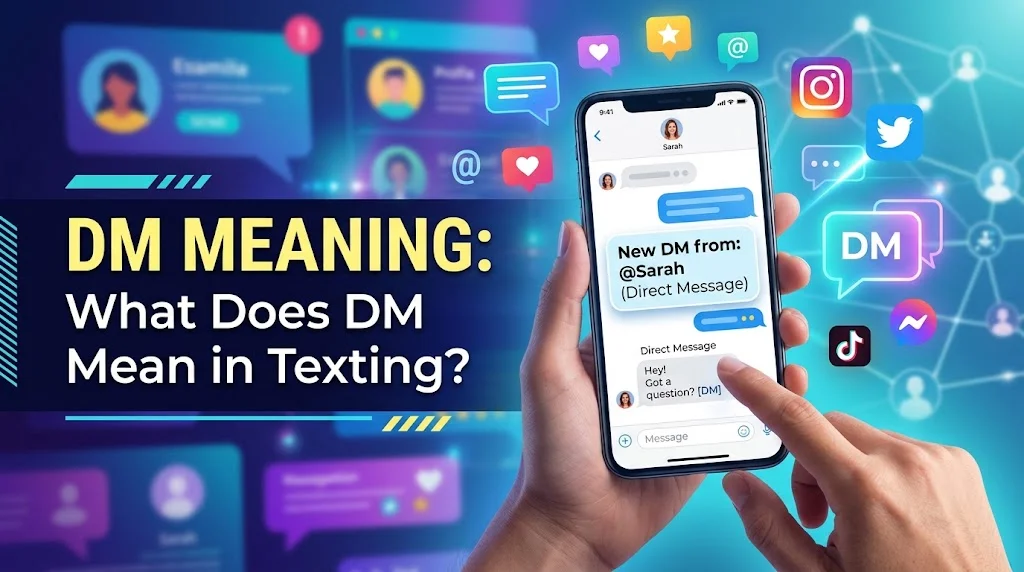
DM meaning is “Direct Message,” a popular term used on social media, texting apps, and online communication platforms. When someone asks you to send them a DM, they want you to contact them through a private message instead of posting a public comment. The term is widely used on platforms like Instagram, TikTok, Facebook, X (Twitter), and other messaging apps.
In everyday conversations, DM makes communication quick, easy, and convenient. For example, if someone comments, “DM me for details,” they are asking you to send them a personal message to discuss something privately. You may also see this abbreviation in online chats, internet slang, digital conversations, and social networking communities.
Understanding DM Meaning can help you communicate more confidently online. Whether you are talking to friends, contacting a business, asking questions, or sharing information, a direct message provides a simple way to connect with someone. However, remember that private chats, online privacy, and digital safety are important when communicating with people you do not know.
Quick Answer
DM means Direct Message. In texting and social media, it refers to a private message sent directly to another person rather than a public post or comment. For example, “DM me” means “Send me a private message.”
TL;DR
- DM: Short for Direct Message.
- DM me: An invitation to send someone a private message.
- Slide into someone’s DMs: To contact someone privately, often with romantic interest.
- Where it’s used: Instagram, TikTok, X, Facebook, and other online platforms.
- Other meanings: Dungeon Master in tabletop gaming and Doctor of Medicine in professional contexts.
- Privacy reminder: A direct message isn’t necessarily confidential or completely private.
What Does DM Stand For?
DM stands for Direct Message, a feature that allows users to communicate privately through an online platform. It provides an alternative to public comments, posts, and replies.
For example, imagine you see a friend’s Instagram story about a new job. You could leave a public comment, or you could send a DM congratulating them privately.
The abbreviation is especially common in informal digital communication. People use it because typing “DM” is quicker than writing “direct message” every time.
Read More: BRB Meaning: What It Means in Texting and Online Chats
DM vs. Public Message
A direct message is generally visible only to the conversation participants, subject to the platform’s policies and technical design. A public comment, by contrast, can usually be viewed by other people who have access to the post.
Here is a simple example:
- Public comment: “Congratulations on your new job!”
- Direct message: “Hey, I saw your new job announcement. I’d love to hear how it happened!”
Both messages express congratulations, but the DM creates an opportunity for a more personal conversation.
What Does DM Mean in Texting?
In texting, DM usually means that someone wants to communicate privately through social media or another messaging service.
Although traditional text messages and direct messages can both be private communications, people often use DM specifically for messages sent through online platforms.
For instance, a friend might text you, “DM me your pictures.” They probably want you to send the pictures through Instagram, Facebook Messenger, or another suitable service.
Common Examples of DM in Texts
Here are several ways people use DM in everyday conversations.
Example 1: Asking for information
Person A: “Do you know where the event is happening?”
Person B: “Yes, I’ll DM you the address.”
Meaning: Person B will send the address privately.
Example 2: Sharing contact details
Person A: “Can you send me the link to that store?”
Person B: “Sure, DM me on Instagram.”
Meaning: Person B wants to continue the conversation through Instagram’s private messaging feature.
Example 3: Starting a conversation
Person A: “I have a question about your project.”
Person B: “Just DM me whenever you’re free.”
Meaning: Person B is inviting a private conversation.
In all three examples, DM refers to sending a direct message rather than posting information publicly.
What Does DM Mean on Instagram, TikTok, and Other Platforms?
The meaning of DM remains essentially the same across most social media platforms, although each service may use different names for its messaging features.
| Platform | How DM Is Commonly Used |
| Sending private messages, photos, reels, and posts | |
| TikTok | Communicating privately with eligible users |
| X (formerly Twitter) | Sending private messages, often called DMs |
| Sending private messages through Messenger | |
| Snapchat | Sending private chats, snaps, or other content |
| Contacting another user privately through available messaging features |
Platform features and privacy settings can change, so the exact options depend on the service and your account.
DM on Instagram
On Instagram, a DM is a message sent through the platform’s messaging system. Users can share text, photos, videos, reels, and other supported content.
For example, if someone posts a picture of a restaurant, you might DM them to ask about its location.
You may also hear people say, “Check your DMs.” This means they want you to open your private messages and read something they sent.
DM on TikTok
On TikTok, DM refers to direct messaging between users who are permitted to message each other under the platform’s current rules and privacy settings.
For example, a creator might ask viewers to DM them with questions about a video. Whether you can send the message depends on the creator’s account settings and TikTok’s messaging requirements.
DM on X and Facebook
On X, users commonly refer to private messages as DMs. Someone might write, “I’ll DM you the information,” instead of sharing it in a public reply.
Facebook users may use DM to describe sending a message through Messenger. Although Messenger is the name of Facebook’s messaging service, people still understand DM as a general term for private online communication.
What Does “DM Me” Mean?
“DM me” means “send me a direct message.” It is a casual invitation to contact someone privately instead of replying publicly.
People use this phrase when they want to share information, answer questions, discuss opportunities, or continue a conversation away from a public post.
For example:
- “DM me for more information.”
- “If you’re interested, DM me.”
- “DM me your username.”
- “DM me when you get home.”
- “DM me for the price.”
The intended meaning depends on the situation. A business may use “DM me for the price” to invite potential customers to ask about a product. A friend may use it to arrange plans or share personal information.
How Should You Reply to “DM Me”?
If someone asks you to DM them, open the appropriate platform and send a private message.
You could write:
“Hey! You asked me to DM you about the event. Can you send me the details?”
A short, friendly message is usually enough. If you don’t know the person well, explain why you’re contacting them so they can understand the context.
What Does “Slide Into DMs” Mean?
“Slide into someone’s DMs” is an informal expression meaning to send someone a private message, often to start a flirtatious or romantic conversation.
The word “slide” makes the action sound casual, smooth, or unexpected. However, the expression doesn’t automatically mean the message is romantic. The context determines the intention.
For example:
“My friend slid into her DMs after seeing her travel pictures.”
This suggests that the friend contacted her privately, possibly because he was interested in her.
The expression can also describe someone reaching out to make friends, discuss a shared interest, or establish a professional connection.
Is Sliding Into DMs Always Romantic?
No. Although the phrase is often associated with flirting, it can also describe ordinary social contact.
For example, a photographer might slide into another photographer’s DMs to discuss a collaboration. Two people who share a hobby might use private messages to get to know each other.
Pay attention to the conversation and the relationship between the people involved rather than assuming every DM has a romantic purpose.
Why Do People Use DMs?
People use direct messages for many reasons, from simple questions to professional conversations. The main advantage is that DMs let users communicate without placing every detail in a public space.
Personal Conversations
Friends and family members use DMs to share updates, pictures, jokes, and personal information.
For example, you might DM a friend about weekend plans instead of discussing every detail in a public comment thread.
Business and Customer Service
Businesses frequently use direct messages to answer questions about products, services, appointments, and orders.
A customer might message a clothing store to ask whether a particular size is available. The store can then respond privately with relevant information.
Networking and Collaboration
Creators, freelancers, and professionals use DMs to introduce themselves, discuss projects, and explore opportunities.
For example, a graphic designer might message a small business owner about creating a logo. A respectful introduction that explains the reason for contacting someone is generally more useful than a vague message.
Sharing Sensitive Information
Some people prefer DMs when discussing matters they don’t want to post publicly. However, direct messages aren’t automatically secure or confidential.
A recipient may save, screenshot, forward, or otherwise share a conversation. Avoid sending passwords, financial details, or other highly sensitive information through a channel unless you’re confident it is appropriate and secure.
What Are the Other Meanings of DM?
Although Direct Message is the most common meaning in social media conversations, DM can stand for different things in other fields.
The surrounding words and topic help determine which definition applies.
| Context | Meaning of DM | Example |
| Texting and social media | Direct Message | “DM me the link.” |
| Tabletop role-playing games | Dungeon Master | “Our DM created a new campaign.” |
| Medical qualifications | Doctor of Medicine | “She earned an MD degree.” |
| Measurement | Decimeter, commonly written as dm | “The object is 3 dm long.” |
| Business and organizations | District Manager, in some workplaces | “Ask the DM about store operations.” |
These meanings aren’t interchangeable. In a conversation about Instagram, Direct Message is the likely interpretation. In a discussion about Dungeons & Dragons, Dungeon Master is more likely.
One additional distinction matters in medicine: the standard abbreviation for Doctor of Medicine is MD, not DM, in the United States. DM may appear in other medical or professional contexts, but its meaning should be confirmed from the surrounding information.
Is DM Different From PM?
DM and PM can both refer to private online communication. However, their wording and usage may vary between platforms and communities.
DM stands for Direct Message, while PM usually stands for Private Message.
Both terms generally describe a message sent directly to another user rather than shared publicly. Some services favor one label, while users may use both terms casually.
For example:
- “DM me on Instagram.”
- “PM me on the forum.”
The first sounds natural in a social media conversation, while the second may be common in an online discussion community.
There isn’t a universal rule requiring every platform to use the same terminology. The service you’re using determines which messaging features are available.
Is DM the Same as a Text Message?
Not necessarily. Both can involve private communication, but they usually refer to different ways of sending messages.
A text message often means an SMS sent through a mobile phone network. A DM usually refers to a message sent through a social media platform or online service.
For example, sending “I’ll be there in ten minutes” through your phone’s SMS app is commonly described as texting. Sending the same words through Instagram is commonly described as a DM.
Some messaging apps blur this distinction because they support internet-based conversations, phone numbers, or multiple communication methods. In everyday speech, people may also use “message” as a general term for both.
The important difference is the service being used, not necessarily the content of the message.
How to Use DM Correctly in a Sentence
DM is informal and works well in texts, online conversations, and casual social media posts. In formal writing, spelling out “direct message” may be clearer, especially when introducing the term to an unfamiliar audience.
Here are some natural examples:
- “I’ll DM you the address later.”
- “She sent me a DM yesterday.”
- “Please DM us if you have any questions.”
- “I received a DM from someone interested in the project.”
- “He asked me to check my DMs.”
DM, DMs, and Direct Message
The singular and plural forms are easy to understand.
- A DM: One direct message.
- DMs: Multiple direct messages or the private message inbox.
- DM me: Send me a direct message.
- DM someone: Contact someone privately through a messaging feature.
For example, “I received three DMs” means that you received three direct messages.
You don’t need to capitalize DM in every casual sentence, although uppercase DM and DMs are common forms. Consistency matters most when writing professionally.
Conclusion
The DM meaning is most commonly “direct message,” a private way to communicate online. Whether someone asks you to DM them, tells you to check your inbox, or sends you a private message, they usually want to talk away from public comments.
Remember that the abbreviation can have other meanings in gaming, business, and different professional settings. Always consider the context to understand what someone means by DM.
FAQs
1. What does DM mean in texting?
DM means “direct message.” It refers to a private message sent through social media or another online communication platform.
2. What does DM mean on Instagram?
On Instagram, DM means direct message. You can use Instagram DMs to send private text messages, photos, videos, reels, and other content.
3. What does “DM me” mean?
“DM me” means “send me a direct message.” The person wants you to contact them privately rather than replying publicly.
4. Is DM the same as PM?
Yes, they have similar meanings. DM stands for direct message, while PM stands for private message. Both describe private online communication.
5. What does DM mean on Snapchat?
On Snapchat, DM generally refers to sending someone a private message through the app’s chat feature.
6. What does DM mean on TikTok?
On TikTok, DM refers to a direct message sent privately to another user, subject to the platform’s messaging settings and restrictions.
7. What does DM mean from a girl or boy?
If a girl or boy says “DM me,” they usually want you to send them a private message. It doesn’t automatically mean they are flirting; the context determines their intention.
8. What are other meanings of DM?
Depending on the context, DM can mean Dungeon Master in role-playing games, District Manager in business, or direct message in social media conversations.

1 thought on “DM Meaning: What Does DM Mean in Texting?”