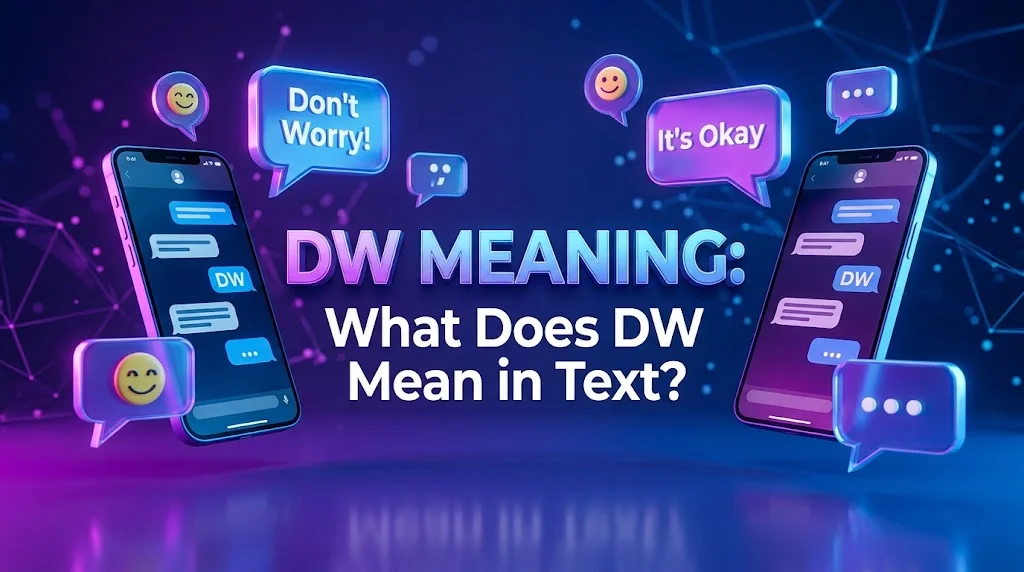
If you have seen DW in a text, chat, social media post, or online conversation, you may wonder what DW meaning is and how people use this short abbreviation. In most casual conversations, DW means “don’t worry.” It is commonly used to reassure someone, show comfort, or let them know that a problem is not serious. For example, someone might text, “DW, I’ll handle it,” meaning “Don’t worry, I’ll handle it.”
The DW abbreviation is especially common in text messages, online chats, social media, and informal communication. Its meaning can depend on the context, so understanding the surrounding conversation is important. While DW slang usually means don’t worry, the abbreviation can have other meanings in different settings, such as daily life, business, technology, or other specialized fields.
In this guide, you’ll learn the DW definition, DW meaning in text, how to use DW in a sentence, and what it means on Snapchat, Instagram, TikTok, and other messaging platforms. You’ll also see simple DW examples to help you understand this popular internet abbreviation.
Quick Answer
DW meaning in most American texts and social media messages is “don’t worry.” It usually reassures someone that a problem is not serious or that they don’t need to feel concerned.
TL;DR
- DW usually means “don’t worry” in casual texting.
- It can reassure someone after an apology or mistake.
- People use DW in texts, chats, comments, and social media.
- Its tone depends on the conversation and relationship.
- DW can also mean “dear wife” in some contexts.
- Context helps you determine the intended meaning.
“DW is commonly used in text messages, social media, and casual online conversations.”
What Does DW Mean in Text?
DW is an informal abbreviation for “don’t worry.” It commonly appears when someone wants to make another person feel less concerned.
For example, imagine that your friend apologizes for being late. You might answer:
“DW, take your time.”
Here, DW means that the delay isn’t a serious problem.
Similarly, someone might text:
“I forgot to bring the tickets.”
You could respond:
“DW, I have them.”
In both cases, DW provides reassurance.
Why Is DW So Short?
Digital communication has encouraged people to shorten familiar expressions. Texting, instant messaging, and social media all make quick communication useful.
As a result, abbreviations such as DW, LOL, BTW, IDK, and TBH became familiar parts of casual online language.
DW follows the same basic pattern. It takes the first letters of don’t and worry and turns them into a quick abbreviation.
What Does DW Stand For?
The most common expansion of DW is “don’t worry.” Dictionaries also recognize other meanings, so the surrounding conversation is important.
Here are the main possibilities:
| DW Meaning | Common Context | Example |
| Don’t worry | Texting and social media | “DW, everything is fine.” |
| Dear wife | Personal or family discussions | “My DW is coming with me.” |
| Darling wife | Informal personal conversations | “My DW loved the movie.” |
| Dishwasher | Some real-estate or property contexts | “DW included in the kitchen.” |
| Doctor Who | Fan discussions and entertainment contexts | “I watched DW last night.” |
The first meaning is by far the most relevant when you receive DW in an ordinary text.
For example, if someone says, “Sorry I missed your call,” and you reply, “DW,” there is little confusion. You are saying, “Don’t worry.”
How Is DW Used in Text Messages?
DW can appear at the beginning, middle, or end of a casual message. It usually works as a short reassurance.
For example:
- “DW, I already took care of it.”
- “You’re running late? DW.”
- “DW about the homework.”
- “Sorry I forgot. — DW, it happens.”
- “DW, we still have plenty of time.”
The abbreviation can also appear in lowercase as dw. Capitalization normally doesn’t change its meaning.
DW After an Apology
One of the most common uses is responding to an apology.
Person A: “Sorry I replied so late.”
Person B: “DW, I was busy too.”
Here, DW tells the other person that there’s no need to feel guilty.
DW During a Problem
DW can also reassure someone when something goes wrong.
Person A: “I think I left my charger at home.”
Person B: “DW, I brought an extra one.”
The phrase works because the second person is reducing the concern.
Is DW Rude or Friendly?
DW is generally casual and reassuring, but its tone can change with context.
A friendly message might say:
“DW! I’ve got everything covered.”
That sounds warm and supportive.
However, replying with only “dw” to someone discussing a serious problem can sometimes feel dismissive. The issue isn’t necessarily the abbreviation itself. Instead, the short response may seem too brief for the situation.
Context Changes the Tone
Consider these two examples:
“DW 😊 You’re going to be fine.”
This sounds supportive.
“dw.”
Depending on the conversation, this could sound neutral, rushed, or dismissive.
Therefore, DW doesn’t automatically communicate one emotional tone. The relationship, situation, punctuation, and surrounding words all matter.
What Does DW Mean on Social Media?
On social media, DW usually has the same meaning: “don’t worry.” It can appear in comments, direct messages, group conversations, and other casual online exchanges.
For example, someone might comment:
“DW, you’ll get it next time.”
Or a friend might send:
“DW about the post. It looks great.”
Because social media favors quick communication, short abbreviations can fit naturally into conversations.
Common Social Media Situations
People may use DW when:
- Reassuring a friend after a mistake
- Responding to an apology
- Telling someone not to stress
- Explaining that something is already handled
- Making a casual conversation shorter
However, users shouldn’t assume every appearance of DW means “don’t worry.” Specialized communities may use the letters differently.
What Does DW Mean From a Guy or Girl?
When someone asks what DW means “from a guy” or “from a girl,” the abbreviation itself usually doesn’t have a special gender-based meaning.
If someone texts “DW, it’s okay,” the basic meaning remains “don’t worry.”
The relationship and conversation provide more information than the sender’s gender.
Look at the Whole Message
For example:
“DW, I’m not upset.”
This clearly uses DW as reassurance.
Meanwhile:
“I’m picking up my DW after work.”
Here, the surrounding words suggest that DW refers to a wife rather than “don’t worry.”
So, instead of guessing from who sent the message, look at what the person is discussing.
What Does DW Mean From a Friend?
Between friends, DW usually means “don’t worry.” It can make a response feel quick, relaxed, and informal.
For example:
Friend: “I forgot to bring your book.”
You: “DW, you can bring it tomorrow.”
The message tells your friend that the mistake isn’t a big issue.
Similarly:
Friend: “I might be 20 minutes late.”
You: “DW, take your time.”
In American texting culture, this kind of shorthand is common because friends often communicate without complete sentences.
Why Friends Use DW
DW can communicate several closely related ideas:
- “It’s okay.”
- “There’s no problem.”
- “You don’t need to stress.”
- “You don’t need to apologize.”
- “I’ve got it handled.”
The exact feeling depends on the conversation.
What Does DW Mean From a Partner?
When used between romantic partners, DW can still mean “don’t worry.” However, relationship and family conversations can also use DW as “dear wife” or “darling wife.”
For example:
“DW, I’ll be home soon.”
Here, DW most likely means “don’t worry.”
But:
“My DW is making dinner tonight.”
Here, DW probably means “dear wife” or “darling wife.”
How Can You Tell the Difference?
Look at the grammar.
If DW appears as a reassurance, it probably means “don’t worry.”
If DW appears after “my” and refers to a person, it may mean “dear wife” or “darling wife.”
That simple clue can solve many cases.
Where Did DW Come From?
DW belongs to the broader history of internet and texting abbreviations. Its modern use developed alongside digital communication, especially as instant messaging and mobile texting became everyday habits.
During the early days of online chatting, users frequently shortened common phrases. Brevity made conversations faster and reduced the amount of typing needed.
The Rise of Text Abbreviations
Digital communication created a new environment for informal language.
People began using short forms such as:
- LOL for “laugh out loud”
- BRB for “be right back”
- BTW for “by the way”
- IDK for “I don’t know”
- TBH for “to be honest”
- DW for “don’t worry”
DW fits naturally into this larger pattern.
It wasn’t necessary to invent a new phrase. Instead, users shortened a phrase they already understood.
From Texting to Social Media
As online communication moved from early instant messaging toward smartphones and social platforms, abbreviations remained useful.
Today, DW can appear across many types of digital conversations. Its meaning is familiar enough that people can often understand it without seeing the full phrase.
DW Meaning in American Digital Culture
In the United States, DW is mainly associated with casual digital communication rather than formal writing.
American texting culture often values speed, informality, and conversational language. Therefore, an abbreviation like DW can make a message feel more relaxed.
Everyday American Examples
You might see DW in conversations about:
- School assignments
- Work schedules
- Social plans
- Minor mistakes
- Late replies
- Missed calls
- Family plans
- Everyday errands
For example:
“Sorry, I forgot to send the address.”
“DW, I already found it.”
This exchange is short but still clear.
However, formal communication is different. In a professional email, writing “don’t worry” is usually clearer than using DW.
What Are the Emotional Associations of DW?
DW often carries a reassuring emotional message. It can signal that someone wants to reduce worry, embarrassment, guilt, or tension.
The emotional meaning isn’t fixed, though. A two-letter response can feel warm in one conversation and abrupt in another.
Common Feelings Behind DW
Depending on context, DW may communicate:
- Reassurance
- Calmness
- Friendliness
- Patience
- Acceptance
- Informality
For example, “DW, everyone makes mistakes” sounds accepting.
By contrast, “DW.” after someone shares a serious concern may provide less emotional support.
Therefore, the words around DW matter just as much as the abbreviation itself.
DW vs. Similar Text Abbreviations
DW is often confused with other short expressions that communicate similar ideas.
Understanding the differences can make texting easier.
| Expression | Meaning | Typical Tone |
| DW | Don’t worry | Reassuring |
| NW | No worries | Friendly |
| NBD | No big deal | Relaxed |
| DWAI | Don’t worry about it | Reassuring |
| It’s okay | Everything is fine | Direct |
| All good | There’s no problem | Casual |
These expressions overlap, but they aren’t always interchangeable.
For example, “NBD” focuses on the size of a problem, while “DW” directly tells someone not to worry.
What Are the Other Meanings of DW?
Although “don’t worry” is the most common meaning in ordinary texting, DW can represent other terms.
Oxford lists “darling wife” or “dear wife” as another informal meaning. Collins also recognizes “dear or darling wife” alongside “don’t worry.”
Dear Wife or Darling Wife
This meaning usually appears when someone is referring to their spouse.
For example:
“My DW and I went to dinner.”
The sentence clearly refers to a person.
Dishwasher
In some American real-estate contexts, DW can be used as an abbreviation for dishwasher. Collins lists this as an American English abbreviation.
Therefore, the surrounding subject matters.
A kitchen listing and a text between friends are very different contexts.
Doctor Who
In entertainment conversations, DW may also be used informally for Doctor Who.
That meaning becomes obvious when the discussion involves episodes, characters, actors, or the television series.
This is why abbreviations should always be interpreted through context.
How Should You Respond to DW?
If someone sends you DW meaning “don’t worry,” you usually don’t need a complicated response.
Your reply can match the casual tone of the conversation.
Simple Responses
You could answer:
“Thanks!”
Or:
“Okay, appreciate it.”
Or:
“Got it!”
If the person is reassuring you after an apology, you might say:
“Thanks for understanding.”
The best response depends on what happened before the DW message.
When DW Means “Dear Wife”
If DW refers to someone’s wife, you don’t need to respond differently because of the abbreviation.
For example:
“My DW and I are visiting Chicago.”
You could simply respond to the actual message rather than focusing on the abbreviation.
Read More:Hi or Hello: What’s the Difference and Which One Should You Use?
Common Misunderstandings About DW
Because DW has several meanings, misunderstandings can happen.
The biggest mistake is assuming that every DW means “don’t worry.”
Context Is the Key
Consider this sentence:
“DW, I already fixed it.”
Here, “don’t worry” makes perfect sense.
Now consider:
“My DW is picking me up.”
Here, “don’t worry” makes no grammatical sense.
The second sentence almost certainly uses DW as a reference to a wife.
Capitalization Usually Isn’t the Answer
Some people wonder whether DW and dw have different meanings.
Usually, they don’t.
In casual digital communication, capitalization often depends on typing habits. The surrounding words provide much stronger clues.
Is DW Appropriate in Formal Writing?
DW is generally considered informal. It works well in casual texts, social media conversations, and messages between people who are comfortable with abbreviations.
However, formal communication usually benefits from writing the complete phrase.
Casual vs. Formal
Casual:
“DW, I can handle it.”
More formal:
“Don’t worry. I can handle it.”
The second version is clearer for professional or formal situations.
Therefore, DW is best treated as conversational shorthand rather than standard formal writing.
How DW Has Changed Over Time
The basic meaning of DW has remained fairly stable in casual texting. However, its surroundings have changed as communication platforms have evolved.
Early digital conversations often centered around instant messaging and SMS. Today, the same abbreviation can appear in social media messages, group chats, gaming communities, and other online spaces.
A Simple Timeline
Early 2000s:
Internet shorthand became increasingly common in instant messaging and mobile texting.
2010s:
Smartphones and social platforms made abbreviated digital language part of everyday communication.
2020s:
DW remains a recognizable shorthand for “don’t worry,” while context-specific meanings continue to exist.
This evolution shows how language adapts to new communication tools without completely replacing older meanings.
Conclusion
The most common DW meaning in texting and online communication is “don’t worry.” People use it as a quick and friendly way to reassure someone, reduce concern, or tell them that everything is fine. For example, “DW about it” simply means “Don’t worry about it.”Because DW is an informal abbreviation, it is best suited to texts, chats, social media, and casual conversations rather than formal writing. Always consider the context, because abbreviations can have different meanings in professional or specialized situations.
FAQs
What does DW mean in texting?
DW usually means “don’t worry” in texting. It is commonly used to reassure someone or tell them that something is okay.
What does DW mean on Snapchat?
On Snapchat, DW generally means “don’t worry.” Someone may use it to comfort or reassure another person during a conversation.
What does DW mean on Instagram?
DW on Instagram usually means “don’t worry.” It can appear in direct messages, comments, captions, or casual conversations.
Is DW slang?
Yes. DW is commonly considered an internet and texting abbreviation used in informal communication.
What does DW mean in a text message?
In a text message, DW most often stands for “don’t worry.” For example, “DW, everything is fine.”
How do you use DW in a sentence?
You can use DW before or after a statement. For example: “DW, I already took care of it.”
Is DW formal or informal?
DW is informal. It is appropriate for casual texts, chats, and social media but is generally not suitable for formal letters or professional documents.
What does “DW about it” mean?
“DW about it” means “Don’t worry about it.” It is a short way to reassure someone that they do not need to be concerned.
Can DW have other meanings?
Yes. Although “don’t worry” is the most common meaning in texting, DW can represent different words or phrases in other contexts. The surrounding context determines its meaning.
What is the difference between DW and DWYM?
DW commonly means “don’t worry,” while DWYM can mean “do what you mean” or have other context-specific meanings. They are different abbreviations.