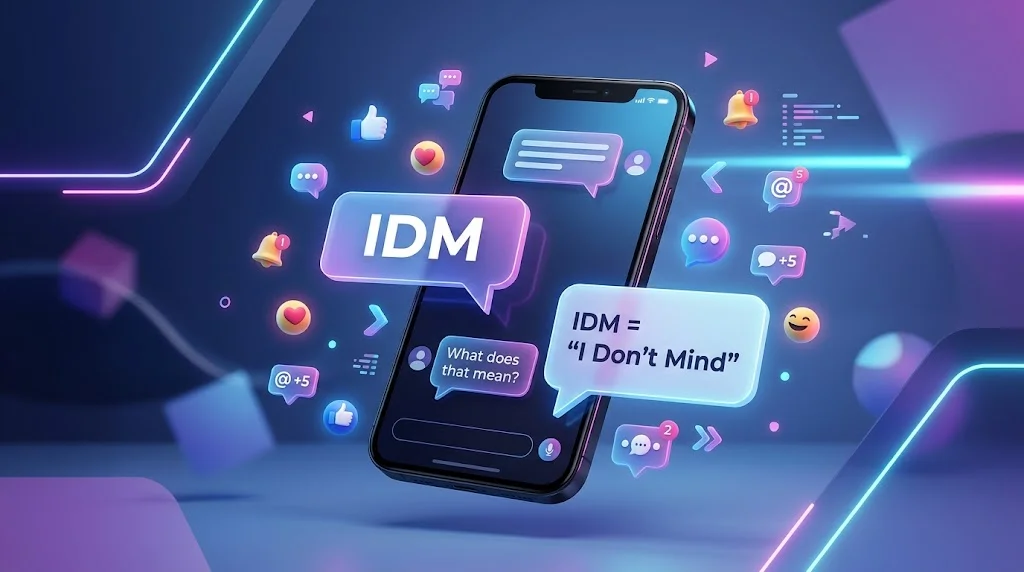
IDM Meaning: What It Means in Text and Chat is a useful phrase to understand if you have seen “IDM” in text messages, social media, or online conversations. In most casual chats, IDM means “I Don’t Mind.” People commonly use this abbreviation when they are comfortable with a suggestion, choice, or situation and do not have a strong preference.
For example, if someone texts, “Do you want pizza or burgers?” you might reply, “IDM.” This simply means you are okay with either option. The abbreviation can make conversations faster and more casual, especially when people are communicating through SMS, WhatsApp, Instagram, Snapchat, or other messaging apps.The exact meaning of IDM in texting can depend on the conversation and context.
While “I Don’t Mind” is the most common meaning, abbreviations can sometimes have different meanings in specific communities or situations. Understanding the surrounding message can help you determine what the sender intends.In this guide, we will explain what IDM means, how to use IDM in a text, common examples, and how it differs from similar texting abbreviations. By the end, you will have a clear understanding of this popular chat abbreviation.
Quick Answer
IDM meaning in texting is usually “I don’t mind.” In the USA, it commonly shows that someone has no strong preference and is comfortable with another person’s choice.
TL;DR
• IDM usually means “I don’t mind” in casual online conversations.
• It often shows flexibility, acceptance, or a lack of preference.
• The abbreviation is common in texting and social media.
• IDM usually sounds softer than “IDC,” meaning “I don’t care.”
• Context can make IDM sound friendly, neutral, or slightly dry.
• Outside texting, IDM can have completely different meanings.
Read More:ML Meaning: What Does ML Mean in Text and Chat?
What Does IDM Mean in Text?
IDM is an initialism for “I don’t mind.” People use it to communicate that something is acceptable to them.
For example, someone might ask, “Pizza or burgers?” A reply of “IDM” means the person is fine with either choice.
Simple Meaning
The basic idea behind IDM is easy:
• “Either option is fine.”
• “You can choose.”
• “I’m okay with that.”
• “It doesn’t bother me.”
• “I have no preference.”
The expression doesn’t necessarily show excitement. Instead, it usually communicates acceptance or flexibility.
Why People Use IDM
Texting encourages people to communicate quickly. Therefore, a three-letter abbreviation can replace a longer sentence without changing the basic message.
Instead of typing, “I don’t mind which restaurant we choose,” someone can simply write, “IDM.”
That makes the expression especially useful during casual conversations.
How Is IDM Used in American Texting?
American texting culture often favors short, informal replies. IDM fits naturally into conversations where people are making small decisions.
Everyday Examples
Imagine a friend asks:
“Should we meet at 5 or 6?”
You could answer:
“IDM, you choose.”
Here, IDM clearly means that either time works.
Another example is:
“Want to watch a comedy or action movie?”
A response might be:
“idm honestly.”
The person is saying they don’t have a strong preference.
Common Situations
You may encounter IDM when people discuss:
• Restaurants and food choices.
• Meeting times and locations.
• Movies, games, or entertainment.
• Weekend plans.
• Group activities.
• Small everyday decisions.
Because the phrase is flexible, its exact meaning depends on what came before it.
What Does IDM Mean on Social Media?
On social platforms, IDM generally keeps the same meaning: “I don’t mind.”
It can appear in direct messages, comments, group conversations, and casual replies. The abbreviation works particularly well when someone wants to give a quick response.
IDM on Instagram and Similar Platforms
A person might ask:
“Can I use this picture for my story?”
A simple response could be:
“IDM :)”
The reply means the person is okay with it.
However, a standalone “idm” may sometimes feel less warm. Text removes vocal tone and facial expressions, so readers have fewer clues about emotion.
Why Context Matters
Consider these two replies:
“idm haha, go for it!”
and:
“idm.”
Both technically communicate the same basic idea. However, the first sounds more enthusiastic and friendly.
The second may sound neutral, tired, or detached depending on the relationship and conversation.
Is IDM the Same as “I Don’t Care”?
IDM and IDC are related, but they aren’t always emotionally identical.
IDM means “I don’t mind.” IDC means “I don’t care.”
The first usually suggests acceptance. The second can suggest stronger indifference.
IDM vs. IDC
| Expression | Full Form | Common Feeling | Typical Meaning |
| IDM | I don’t mind | Neutral or relaxed | Either option is acceptable |
| IDC | I don’t care | More detached | The choice doesn’t matter to me |
| IDK | I don’t know | Uncertain | I don’t have the answer |
| IMO | In my opinion | Informal | Sharing a personal view |
| NVM | Never mind | Context-dependent | Forget or disregard something |
For example, “IDM where we eat” usually sounds more cooperative than “IDC where we eat.”
Still, these impressions can change based on the conversation.
When IDM Sounds More Positive
Adding a few words can make the meaning clearer.
For example:
“IDM, whatever works for you.”
This sounds flexible and considerate.
Similarly:
“IDM haha, you pick.”
The extra wording makes the message feel casual rather than cold.
Does IDM Have a Positive or Negative Meaning?
IDM is generally neutral. It doesn’t automatically express either strong approval or disapproval.
A Positive Use
Someone might say:
“Do you want the window seat?”
“IDM, you can have it.”
Here, IDM shows generosity or flexibility.
A Neutral Use
Someone might respond:
“Tea or coffee?”
“IDM.”
The person simply has no preference.
A Potentially Negative Tone
In some conversations, a short IDM can sound dismissive.
For example:
“Do you actually want to come with us?”
“idm.”
The reply could be interpreted as a lack of enthusiasm.
That doesn’t mean the sender intended to be rude. Text communication often leaves emotional details unclear.
Why Can IDM Sound Dry in a Text?
The emotional tone of spoken language comes from voice, facial expressions, pauses, and body language. Text messages remove most of those signals.
As a result, short replies can sometimes feel colder than intended.
What Changes the Tone?
Several details can influence how IDM is interpreted:
• The relationship between the people.
• The question being answered.
• Punctuation and capitalization.
• Emojis or playful wording.
• Previous messages in the conversation.
For example, “IDM 😊” may feel warmer than simply “idm.”
Likewise, “idm, honestly” can sound more conversational than a one-word response.
Short Replies Aren’t Always Rude
It’s important not to assume negative intent from a short message.
Someone may be busy, distracted, or typing quickly. They may genuinely mean that they have no preference.
Therefore, the surrounding conversation is usually more useful than the abbreviation alone.
How Did IDM Become a Texting Abbreviation?
IDM comes from shortening the ordinary phrase “I don’t mind.”
The abbreviation follows a common pattern in digital communication. People take the first letters of words and use them to create a faster form.
From Phrase to Initialism
The phrase contains three main words:
I + Don’t + Mind = IDM
This kind of shortening became especially useful in online communication and text messaging.
Early digital conversations encouraged compact language because typing could be slower and message limits could matter. Over time, abbreviations became a normal part of informal internet communication.
Modern Digital Communication
Today, people use abbreviations across many forms of communication.
Examples include:
• IDK for “I don’t know.”
• IMO for “in my opinion.”
• BTW for “by the way.”
• NVM for “never mind.”
• IDC for “I don’t care.”
IDM fits naturally into this larger pattern of conversational shorthand.
What Does IDM Mean in Different Contexts?
Although “I don’t mind” is common in casual texting, IDM can have other meanings.
This is an important distinction because abbreviations don’t always have one universal definition.
Technology and Software
In technology discussions, IDM may refer to Internet Download Manager, a software application associated with downloading files.
Therefore, someone discussing computer software may not be talking about texting slang at all.
Music
IDM can also refer to intelligent dance music, a term associated with electronic music.
In a music discussion, the letters may therefore describe a genre or style rather than “I don’t mind.”
Business and Technology
IDM can also appear as an abbreviation for identity management in technology and business contexts.
The surrounding subject usually makes the intended meaning clear.
Context Is the Key
| Conversation Context | Possible IDM Meaning | How to Interpret It |
| Texting with friends | I don’t mind | Usually means no strong preference |
| Social media chat | I don’t mind | Usually casual acceptance |
| Computer discussion | Internet Download Manager | Software-related meaning |
| Electronic music discussion | Intelligent dance music | Music-related meaning |
| Business technology | Identity management | Technology-related meaning |
The texting meaning is therefore only one use of IDM. Wiktionary also records “I don’t mind” as an internet-slang meaning while listing several other meanings.
What Does IDM Mean in Different Relationships?
The same abbreviation can feel different depending on who sends it.
Friends may use IDM casually without worrying about how it sounds. However, a similar reply between coworkers, romantic partners, or unfamiliar people may require more context.
Between Friends
Among friends, “idm” is usually easygoing.
“Beach or movies?”
“idm, you choose.”
The message simply communicates flexibility.
In Romantic Conversations
Context becomes more important in dating or romantic conversations.
For example:
“Do you want to talk tonight?”
“IDM.”
This might mean genuine flexibility. However, the recipient could also wonder whether the person actually wants to talk.
A warmer reply would make the intention clearer.
At Work
IDM is generally informal. A complete sentence is often clearer in professional communication.
Instead of:
“IDM.”
You could write:
“Either option works for me.”
That removes uncertainty and sounds more polished.
How Should You Reply to “IDM”?
Your response depends on what the other person is discussing.
If someone says IDM after you offer two choices, you can simply make the decision.
Easy Replies
You could respond with:
“Okay, let’s go with 6.”
Or:
“Sounds good. I’ll pick the restaurant.”
If you want to confirm their preference, you can ask:
“So either one works for you?”
This is useful when the decision matters.
If the Message Feels Cold
Don’t immediately assume the person is annoyed.
Instead, consider the entire conversation. If you’re still unsure, ask directly.
For example:
“No preference, or would you rather do something else?”
A simple clarification can prevent unnecessary misunderstandings.
Is IDM Appropriate for Professional Messages?
IDM is mainly a casual abbreviation. Therefore, it’s usually better suited to informal communication.
In a workplace setting, clarity often matters more than saving a few keystrokes.
More Professional Alternatives
Instead of IDM, consider:
• “Either option works for me.”
• “I’m fine with either choice.”
• “I don’t have a preference.”
• “Whatever works best for the team.”
• “That works for me.”
These expressions make your meaning immediately clear.
Why Full Sentences Help
Professional communication can involve people from different age groups and communication styles.
Not everyone knows every internet abbreviation. A complete sentence reduces the chance of confusion.
Common Misunderstandings About IDM
Because IDM is short, people sometimes assign meanings that aren’t actually intended.
IDM Does Not Always Mean Disinterest
Someone saying “I don’t mind” isn’t necessarily bored.
They may genuinely be comfortable with either option.
IDM Doesn’t Mean “Yes” in Every Situation
IDM usually expresses acceptance, but it isn’t always enthusiastic agreement.
For example:
“Do you mind if I sit here?”
“IDM.”
Here, the speaker means the person can sit there.
However, the response doesn’t necessarily communicate excitement about the situation.
Capitalization Usually Doesn’t Change the Meaning
“IDM,” “idm,” and “Idm” can represent the same phrase.
Lowercase writing often feels more casual, while uppercase letters may simply reflect a person’s typing habits.
How IDM Fits Into Modern Internet Language
Internet language continues to change as people communicate through phones, social platforms, gaming communities, and private messages.
Short abbreviations help users respond quickly.
Digital Language Is Contextual
A single abbreviation can carry different meanings across communities.
That’s why it’s risky to interpret three letters without reading the surrounding conversation.
IDM is a good example. In one chat, it means “I don’t mind.” In a software discussion, it could refer to a completely different subject.
Meaning Depends on Use
Modern digital language isn’t only about dictionary definitions.
It also involves tone, relationship, timing, and context.
That’s why “idm” can feel friendly in one conversation and slightly distant in another.
Conclusion
IDM usually means “I Don’t Mind” in texting and online conversations. It is commonly used to show that you are okay with something, have no preference, or are comfortable with another person’s choice. Its meaning is generally easy to understand from the surrounding conversation.For example, “Where should we eat?” followed by “IDM” means the person is happy to let the other person choose. Because IDM is informal, it works best in texts, chats, social media messages, and casual conversations rather than formal writing. Always consider the context before interpreting an abbreviation, especially when it could have another meaning.
FAQs
What does IDM mean in text?
In text messages, IDM most commonly means “I Don’t Mind.” It indicates that someone has no strong preference about a choice or situation.
What does IDM mean in chat?
IDM in chat usually means “I Don’t Mind.” It is a casual way to tell someone that you are okay with their suggestion or decision.
What does IDM stand for?
IDM most commonly stands for “I Don’t Mind” when used in texting and online conversations.
How do you use IDM in a sentence?
You can use IDM when you do not have a preference. For example: “Which movie should we watch?” — “IDM, you choose.”
Is IDM rude in texting?
No. IDM is generally not rude. However, because it is brief, the tone can sometimes seem indifferent depending on the conversation.
Can IDM mean something else?
Yes. Abbreviations can have different meanings in different contexts. In everyday texting, however, “I Don’t Mind” is a common interpretation of IDM.
Is IDM formal or informal?
IDM is informal. It is mainly used in texts, chats, social media, and casual online conversations rather than formal emails or professional writing.




1 thought on “IDM Meaning: What It Means in Text and Chat”