
When you’re writing or speaking in English, choosing between in the same day and on the same day can be confusing. Both expressions refer to events happening within a similar period, but they aren’t always used in the same way. Understanding the difference can help you write more natural English sentences and avoid common grammar mistakes.
The phrase on the same day is generally the standard choice when you’re talking about a specific day or date. For example, “I received the package on the same day I placed the order.” On the other hand, in the same day is much less common and can sound unnatural when you’re referring to a particular day. However, in the same day may appear when you’re emphasizing what happens within a single day or discussing the amount of time available.
Knowing when to use on the same day can improve your English grammar, sentence structure, and everyday communication. In this guide, you’ll learn the difference between in the same day and on the same day, see practical example sentences, and discover which expression is correct in different contexts. By the end, you’ll know how to use these phrases confidently in spoken English and written English.
Quick Summary
“On the same day” is the correct and most common phrase in English when talking about something that happened or will happen on a particular day. For example, “We finished the project on the same day.” “In the same day” is used less often and usually means something happened within a single 24-hour period, such as “She traveled to three cities in the same day.” Knowing the difference helps you write and speak more naturally. When you mean a specific date or occasion, choose “on the same day.” When you want to emphasize that several things happened within one day, “in the same day” is the better choice. Understanding this simple rule will help you avoid common grammar mistakes.
Why “In the Same Day” vs “On the Same Day” Confuses So Many Writers
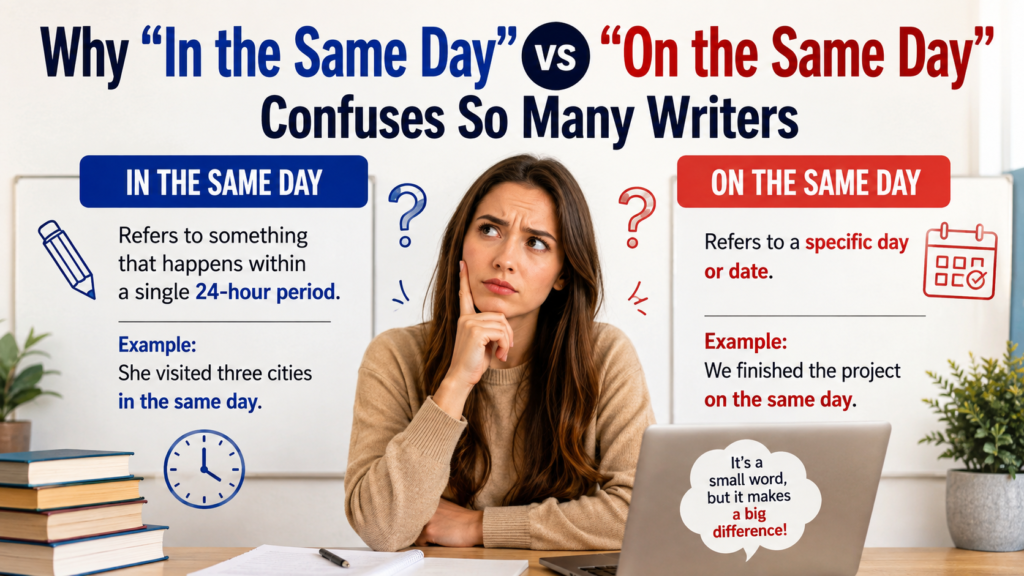
At first glance, both phrases seem interchangeable. They share the same words. They point to the same idea. Still, they don’t behave the same way.
Here’s the issue:
- English prepositions don’t follow strict logic
- “In” and “on” carry subtle meaning differences
- Native speakers rely on instinct more than rules
That last point matters. When something sounds wrong, it often is.
Quick insight: Most fluent English speakers say “on the same day” without thinking twice. That’s your strongest clue.
The Short Answer: Which One Should You Use?
Let’s cut through the noise.
- ✅ Use “on the same day” in almost all situations
- ⚠️ Use “in the same day” only when you mean within a 24-hour period
Simple Examples
- ✔️ We finished the project on the same day.
- ⚠️ We finished the project in the same day. (technically possible, but less natural)
If you want your writing to sound clean and fluent, default to “on the same day.”
What Does “On the Same Day” Really Mean?
Core Meaning
“On the same day” refers to a specific calendar day. It connects events to a shared point in time.
You’re not talking about duration. You’re pointing to a date.
When to Use “On the Same Day”
Use it when you describe:
- Events happening on a specific date
- Tasks completed on a particular day
- Meetings, deadlines, or schedules
- Stories involving timelines
Real-Life Examples
- We had two meetings on the same day.
- She was hired and promoted on the same day.
- The package arrived on the same day I ordered it.
Why It Sounds Natural
English treats days like surfaces, not containers.
That’s why we say:
- On Monday
- On July 5th
- On the same day
This pattern stays consistent. Once you see it, it sticks.
What Does “In the Same Day” Mean?

Core Meaning
“In the same day” focuses on duration within a single day. It highlights how quickly something happened.
You’re not pointing to a date. You’re emphasizing completion within a time span.
When You Can Use “In the Same Day”
Use it when you want to stress:
- Speed
- Efficiency
- Completion within hours
Examples Where It Works
- He wrote the entire report in the same day.
- They traveled across two cities in the same day.
- She solved all the problems in the same day.
Why It Often Feels Unnatural
Even when it’s correct, it can sound slightly awkward.
Why?
- English speakers rarely treat “day” as a container
- “Within the same day” sounds more natural
- “On the same day” fits more situations
Better alternative: Instead of “in the same day,” try “within the same day” for clarity.
On the Same Day vs In the Same Day: Side-by-Side Comparison
Here’s a clear breakdown you can scan in seconds:
| Phrase | Meaning Focus | Common Usage | Example |
| On the same day | Specific calendar date | Very common | We met on the same day |
| In the same day | Duration within a day | Less common | She finished it in the same day |
| Within the same day | Time limit emphasis | Natural alternative | The order shipped within the same day |
The Grammar Behind “On” vs “In” (Without the Boring Rules)
How Prepositions Work Here
- “On” → Used for days and dates
- “In” → Used for time periods or durations
Examples That Make It Click
| Preposition | Usage Type | Example |
| On | Specific day | On Friday |
| On | Exact date | On May 1st |
| In | Month/year | In 2025 |
| In | Duration | In two hours |
Quick Rule You Can Remember
- If you mean a date → use “on”
- If you mean time taken → “in” (rare case)
Common Mistakes and How to Fix Them
Mistakes happen when you translate directly or overthink the sentence.
Mistake 1: Using “In” for Dates
❌ We completed everything in the same day.
✔️ We completed everything on the same day.
Mistake 2: Overcomplicating Simple Sentences
❌ The task was accomplished in the same day period.
✔️ We finished the task on the same day.
Mistake 3: Literal Translation from Other Languages
Some languages treat time differently. That leads to unnatural phrasing in English.
Fix Strategy
When unsure:
- Replace the phrase with a real date
- If “on” fits, use it
Example:
We finished it on Monday → on the same day
Read More: Conform To vs. Conform With — The Real Difference Explained (With Clear Examples)
Real-Life Use Cases of “On the Same Day”
Professional Emails
Clear communication matters at work.
- Let’s schedule both meetings on the same day.
- We can complete the review on the same day.
Academic Writing
Precision counts in essays and research.
- Both experiments were conducted on the same day.
Everyday Conversation
You’ll hear this often in casual speech.
- We met and became friends on the same day.
Case Study: How One Phrase Changes Clarity
Scenario
A company promises fast delivery.
Version A
We deliver all orders in the same day.
Sounds slightly off. The message feels unclear.
Version B
We deliver all orders on the same day.
Now it feels natural and confident.
Version C (Best)
We deliver all orders within the same day.
This version removes ambiguity completely.
Takeaway
Small wording changes can:
- Improve clarity
- Build trust
- Make writing sound more professional
Native Speaker Insight: What Sounds Right Instantly
Native speakers rarely pause to analyze grammar. They rely on instinct shaped by exposure.
That instinct favors:
- “On the same day” → default choice
- “In the same day” → rare, situational
Quote: “If it sounds slightly off, it probably is.” — Common writing advice among editors
Quick Practice: Test Your Understanding
Fill in the blanks:
- We submitted both applications ___ the same day.
- She completed the entire project ___ the same day.
- The package arrived ___ the same day it was shipped.
Answers
- on the same day
- in the same day (acceptable but less natural)
- on the same day
Pro Tips to Never Confuse These Again
Think in Terms of Meaning
- Calendar date → “on”
- Time duration → “in”
Use the “Replace Test”
Swap with a real date:
- On Monday → on the same day
Say It Out Loud
Your ear often catches what your brain misses.
Keep It Simple
When in doubt, choose clarity over cleverness.
Better Alternatives You Can Use
Sometimes neither phrase fits perfectly. Try these:
- Within the same day
- Later that day
- That same day
- By the end of the day
Example Comparison
| Phrase | Tone | Clarity |
| On the same day | Natural | High |
| In the same day | Slightly off | Medium |
| Within the same day | Precise | Very High |
FAQs
Is it “in the same day” or “on the same day”?
“On the same day” is generally the correct and natural expression when you mean that something happened on the same calendar day.
Is “in the same day” grammatically correct?
“In the same day” can appear in some contexts, but “on the same day” is usually the natural choice when referring to a specific day.
What does “on the same day” mean?
“On the same day” means that two or more events happened during the same calendar day.
Can I say “in the same day”?
You can encounter “in the same day,” particularly when emphasizing a period or timeframe, but “on the same day” is normally better for a specific calendar date.
Which is more common: “in the same day” or “on the same day”?
“On the same day” is much more natural when talking about events occurring on one particular day.
What is an example of “on the same day”?
For example: “She submitted the application and received a response on the same day.”
What is the difference between “in the same day” and “on the same day”?
“On the same day” identifies a specific calendar day. “In the same day” can emphasize a period within a day, although it is less common in standard usage.
Conclusion
“On the same day” is the best and most natural choice when you’re talking about two events that happened on one particular calendar day. For example, “I placed the order and received it on the same day.” Although you may occasionally see “in the same day,” it usually doesn’t sound as natural in this context. Choosing “on the same day” will make your writing clearer and more idiomatic, especially in professional, academic, and everyday English.