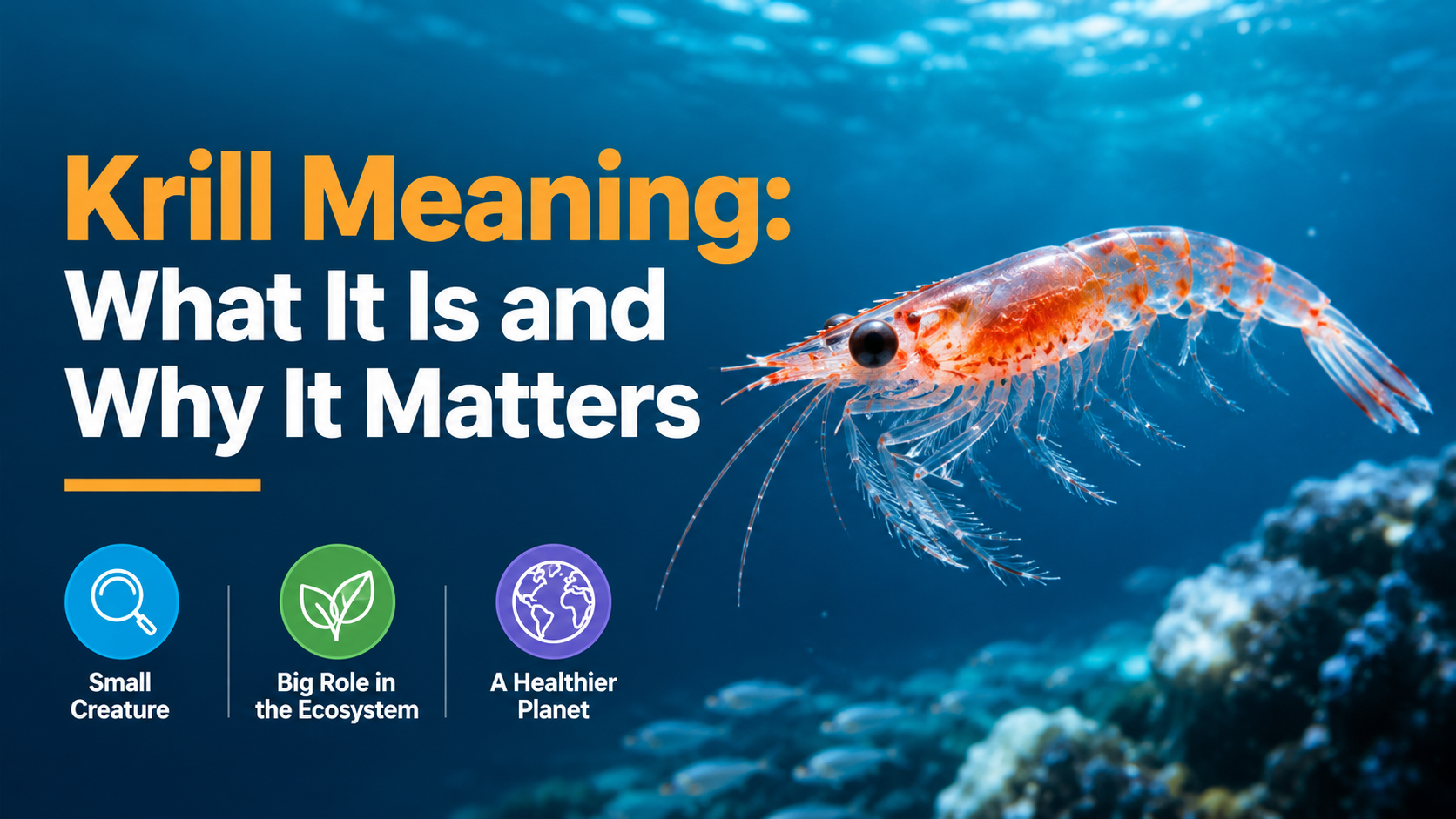
Krill Meaning refers to the definition, characteristics, and symbolism associated with krill, tiny shrimp-like marine animals that live mainly in oceans around the world. Although krill are small, they play a major role in the marine ecosystem and support many larger animals. They are an important part of the ocean food chain, especially for whales, seals, penguins, fish, and seabirds. Because of this role, krill can symbolize interdependence, community, survival, and the importance of seemingly small things.
From a biological perspective, krill are small crustaceans belonging to the order Euphausiacea. They often gather in enormous groups called krill swarms, sometimes covering large areas of the ocean. Their ability to live collectively highlights the power of cooperation and shared survival. In symbolism, this makes krill an interesting representation of unity, collective strength, and ecological balance.
In modern discussions, krill are also connected with Antarctic krill, marine life, whale food, ocean conservation, and biodiversity. Understanding Krill Meaning therefore involves more than simply defining the animal. It also reveals how nature shows that even the smallest creatures can have a significant impact on the wider world.
Quick Answer
Krill meaning in the USA mainly refers to tiny ocean animals that serve as a major food source for whales, fish, seabirds, and other marine life. Symbolically, krill can suggest interconnection, abundance, teamwork, and the power of small organisms.
TL;DR
• Krill are tiny shrimp-like animals found throughout the world’s oceans.
• They form a major food source for many marine animals.
• Antarctic krill are especially important in Southern Ocean ecosystems.
• Their symbolic meaning often centers on connection and collective strength.
• In America, krill are linked with whales, conservation, and ocean science.
• Modern discussions also include krill oil and sustainable harvesting.
What Is Krill?
Krill are small crustaceans that belong to the order Euphausiacea. They look somewhat like miniature shrimp, although they aren’t the same animal.
Most krill live in large groups called swarms. These groups can contain enormous numbers of individuals and may stretch across large areas of the ocean.
What Do Krill Look Like?
Krill usually have slender bodies, multiple legs, large eyes, and a hard outer shell. Their bodies can appear almost transparent, although some species have reddish or orange coloring.
They also have special structures that help them feed on tiny organisms. Many species eat phytoplankton, microscopic organisms that form the foundation of many ocean food webs.
Where Do Krill Live?
Krill live in oceans across the planet. However, different species occupy different marine environments.
Antarctic krill are particularly well known. They live in the cold waters surrounding Antarctica and support a large community of marine animals.
Other krill species occur in northern oceans and temperate waters. Their distribution makes them important to many different marine ecosystems.
What Do Krill Symbolize?
Krill don’t have a universal symbolic tradition like roses or stars. However, their biological role creates several useful symbolic associations.
Small Things Can Have Big Effects
Krill are physically small, yet their ecological importance is enormous. This creates a natural metaphor for small actions producing large results.
For example, a person may use krill as a symbol of humility. Something doesn’t need to be large to matter.
Collective Strength
A single krill has limited influence. A massive swarm, however, can become a major source of food for larger animals.
Therefore, krill can represent cooperation, community, and collective strength.
Common Symbolic Associations
• Interdependence — life depends on relationships between different organisms.
• Abundance — huge swarms demonstrate nature’s ability to produce enormous numbers.
• Resilience — krill survive in challenging marine environments.
• Humility — their small size contrasts with their enormous ecological importance.
• Connection — krill link microscopic producers with massive ocean predators.
What Is the History of Krill?
The history of krill is mainly a story from marine science rather than mythology. Ancient coastal societies certainly encountered small marine animals, but krill weren’t commonly treated as a distinct symbolic creature.
Modern scientific understanding developed as researchers began studying microscopic and small marine life more closely.
The Meaning of the Word
The English word krill comes from Norwegian. It was used for small fish or whale food and became associated with these tiny crustaceans.
The word became especially important as scientists investigated the diets of whales and other marine animals.
From Whale Food to Ecosystem Science
For many years, people often viewed krill mainly as something whales eat. Modern marine science provides a much broader picture.
Researchers now understand krill as important links between tiny organisms and larger animals. This makes them central to studies of ocean food webs and ecosystem health.
What Is the Role of Krill in the Ocean?
Krill occupy an important position within many marine food chains. They consume microscopic organisms and are then eaten by larger animals.
This creates a connection between plankton and major marine predators.
Who Eats Krill?
Many animals depend on krill as part of their diets. The exact importance varies by species and location.
Common krill predators include:
• Baleen whales such as humpback and blue whales
• Penguins living around Antarctic waters
• Seals and other marine mammals
• Fish including several commercially important species
• Seabirds that feed in productive ocean regions
Because so many animals depend on them, changes in krill populations can affect other species.
Why Are Krill So Important?
Krill transfer energy through marine food webs. They consume smaller organisms and become food for much larger animals.
As a result, their importance isn’t determined by their size. Instead, it comes from their position within the ecosystem.
What Does Krill Mean in America?
In the United States, krill are most commonly understood through science, conservation, fishing, and popular nature media.
Americans may encounter the word when learning about whales or watching documentaries about Antarctica. Krill also appear in conversations about ocean health and sustainable fishing.
Krill and American Ocean Culture
Whales are especially powerful symbols in American environmental culture. Because many whales eat enormous amounts of krill, the two animals are often connected in educational discussions.
Krill can therefore represent the hidden foundations behind spectacular marine life.
A whale may capture attention, but its food supply tells another story. This relationship helps illustrate how ecosystems work.
Krill and Environmental Awareness
Krill are also connected with concerns about changing ocean conditions. Temperature, sea ice, food availability, and fishing pressure can influence populations.
Therefore, krill sometimes become a symbol of ecological balance and environmental responsibility.
Krill and the Antarctic Ecosystem
Antarctic krill are among the best-known species. They are especially important because many Antarctic animals depend on them.
The Southern Ocean contains a complex network of relationships involving krill, algae, fish, penguins, seals, and whales.
Why Antarctic Krill Matter
Antarctic krill feed heavily on microscopic food sources. They can also survive periods when environmental conditions change dramatically.
Their seasonal movements help connect different parts of the Southern Ocean ecosystem.
A Symbol of Hidden Foundations
Antarctic krill offer a useful lesson about nature. The animals people notice most aren’t always the most important ones.
Instead, tiny organisms may support entire communities.
That idea gives krill a broader symbolic meaning: the unseen foundation beneath visible success.
Krill Meaning in Food and Nutrition
Krill also appear in American consumer culture through krill oil. Krill oil is made from harvested krill and is commonly marketed as a source of omega-3 fatty acids.
However, the meaning of krill changes in this context. Here, the animal becomes associated with nutrition, wellness products, and marine resources.
Krill Oil and Modern Culture
People may encounter krill oil in stores, online advertisements, or discussions about dietary supplements.
It’s important to distinguish the animal itself from claims made about products containing it. Scientific evidence and product quality can vary, so consumers should evaluate health claims carefully.
The broader cultural issue is sustainability. People increasingly ask whether harvesting marine organisms can occur without harming ecosystems.
How Does Krill Compare With Shrimp?
Krill and shrimp look similar because both are crustaceans. However, they belong to different groups and have important biological differences.
Krill are especially adapted to life in open ocean environments. Their ecological role is also strongly connected with plankton-based food webs.
Similarities and Differences
| Context | Krill | Shrimp |
| Animal group | Small marine crustaceans | Crustaceans with many marine and freshwater species |
| Typical role | Major food-web connection | Food source and important aquatic consumer |
| Appearance | Small, translucent, shrimp-like | Usually larger and more varied |
| Human use | Mainly scientific and supplement-related | Widely eaten as seafood |
| Cultural image | Whales and ocean ecosystems | Food, fishing, and cuisine |
The resemblance can cause confusion. However, calling krill simply “tiny shrimp” misses their distinct biology and ecological role.
What Does Krill Symbolize Spiritually?
Krill don’t have a major universal spiritual tradition. Still, people can interpret their natural behavior through broader spiritual ideas.
These interpretations are modern and personal rather than fixed religious teachings.
Interconnection
Krill demonstrate how individual life forms connect within a larger system. This can inspire reflections about community and dependence.
Humility and Perspective
Their tiny bodies contrast sharply with the huge animals that depend on them. Symbolically, this can encourage humility.
A small contribution may still support something much larger.
Collective Existence
A krill swarm can be viewed as an image of collective movement. The individual remains small, while the group becomes highly significant.
This can symbolize unity without requiring sameness.
What Are the Emotional and Psychological Associations of Krill?
Because krill are small and often unseen, they can evoke different emotional responses.
For some people, they represent vulnerability. For others, their enormous numbers suggest strength and resilience.
Common Psychological Themes
• Humility — importance doesn’t always require visibility.
• Belonging — individuals can function within larger communities.
• Resilience — survival can occur despite difficult conditions.
• Perspective — size doesn’t determine significance.
• Interdependence — every part can affect the larger system.
These ideas can make krill an interesting metaphor for everyday life.
A person might compare a small act of kindness to a single krill. Alone, it seems minor. Yet thousands of small actions can create meaningful change.
How Are Krill Used in Modern Culture?
Krill appear most often in science education, nature media, conservation campaigns, and discussions about whales.
They’re less common as decorative symbols than animals such as dolphins, sharks, or whales.
Krill in Education
Teachers may use krill to explain food chains and ecosystems. They’re especially useful because they demonstrate how energy moves through different levels of life.
For example, students can follow a simple chain:
Phytoplankton → Krill → Fish or Whales → Larger Ecosystem
This makes an abstract ecological concept easier to understand.
Krill in Media
Nature documentaries often mention krill when showing whales feeding. Dramatic footage of massive swarms can also make these tiny animals visually memorable.
As a result, krill have become part of the broader public image of the ocean.
Are Krill Used in Tattoos or Art?
Krill tattoos are uncommon compared with whale, shark, octopus, or dolphin tattoos. However, someone choosing a krill design could give it a deeply personal meaning.
Possible Krill Tattoo Meanings
• Small but powerful — representing influence despite modest beginnings.
• Community — honoring friendship, family, or collective identity.
• Ocean connection — expressing love for marine environments.
• Hidden importance — remembering that unseen work still matters.
• Resilience — representing survival through difficult circumstances.
A swarm design could emphasize community. A single krill could emphasize individuality and quiet strength.
Can Krill Represent Abundance?
Yes, abundance is one of the strongest symbolic ideas connected with krill.
Some species gather in enormous swarms. These gatherings demonstrate how countless small individuals can form something much larger.
Abundance Versus Overabundance
However, abundance doesn’t always mean unlimited resources. Marine ecosystems have limits.
Krill populations can be affected by environmental conditions and human activity. Therefore, krill can also symbolize the delicate balance between abundance and sustainability.
Are There Controversies About Krill?
Most controversies surrounding krill are ecological rather than symbolic.
The main concern involves harvesting krill from marine environments where other animals depend on them.
Fishing and Ecosystem Concerns
Krill are commercially harvested in some parts of the world. They’re used for products including animal feed, aquaculture inputs, and supplements.
This raises an important question: how much can humans harvest while maintaining healthy ecosystems?
Different scientists, conservation groups, industries, and regulators may approach that question differently.
Why Context Matters
It’s misleading to treat all krill harvesting as automatically harmful or automatically harmless. Species, location, harvesting methods, population conditions, and management rules all matter.
Therefore, discussions about krill should consider the wider ecosystem rather than focusing only on the animal itself.
How Has the Meaning of Krill Changed Over Time?
The public image of krill has changed significantly.
Earlier descriptions often focused on krill as simple food for whales. Today, krill are more often discussed as essential components of marine ecosystems.
From Small Creature to Ecosystem Symbol
The change reflects a broader shift in ecological thinking.
Scientists and the public increasingly recognize that ecosystems depend on relationships. Consequently, krill can represent the importance of overlooked parts of nature.
Modern Interpretation
Today, krill can suggest several connected ideas:
smallness, abundance, connection, resilience, and ecological balance.
These meanings aren’t ancient universal symbols. Instead, they’re modern interpretations inspired by krill’s real biological role.
Why Do Krill Matter So Much?
Krill matter because ecosystems aren’t built only from large and impressive animals.
Instead, life often depends on countless smaller organisms working through natural food webs.
The Bigger Lesson
A whale is easy to notice. Krill are much harder to see.
Yet the whale’s survival may depend heavily on access to suitable food. This relationship provides a powerful lesson about nature.
The lesson is simple: importance isn’t always visible.
That idea also explains why krill have become useful in environmental education. They help people see the connections behind a healthy ocean.
FAQs
What does krill mean?
Krill refers to small marine crustaceans that resemble tiny shrimp. They are important food sources for whales, fish, seabirds, and other marine animals.
What does krill symbolize?
Krill can symbolize interdependence, abundance, humility, resilience, and collective strength. These meanings come mainly from their ecological role rather than ancient symbolic traditions.
Why are krill important to whales?
Many baleen whales consume large quantities of krill. Krill provide an important source of energy that supports these enormous marine mammals.
Are krill and shrimp the same thing?
No. Krill and shrimp are different groups of crustaceans, although they look similar. Krill have a distinct ecological role within ocean food webs.
What is the spiritual meaning of krill?
There isn’t one universal spiritual meaning for krill. Modern personal interpretations may connect them with unity, humility, interconnection, and hidden strength.
Why are Antarctic krill important?
Antarctic krill are a major food source for many Southern Ocean animals. Their role connects microscopic food sources with larger predators such as whales, seals, penguins, and fish.
Conclusion
Krill meaning goes far beyond the idea of a tiny ocean animal. Krill can represent interconnection, abundance, humility, resilience, and collective strength because their ecological influence is far greater than their size suggests.
In the USA, krill are most strongly associated with whales, ocean science, conservation, and marine ecosystems. They also offer a useful reminder that nature depends on relationships between creatures of every size.