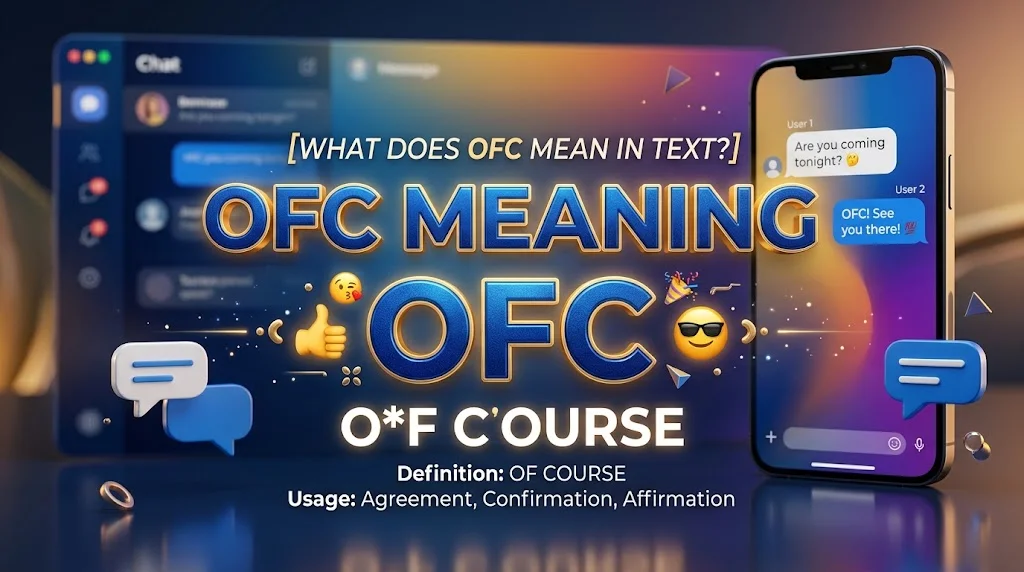
If you have seen OFC in a text, comment, Snapchat message, Instagram post, or online conversation, you may wonder what this short abbreviation means. OFC meaning is usually “of course,” a casual expression people use to show agreement, confirmation, or that something is obvious. It is especially common in texting, social media, and online slang.
For example, someone might ask, “Are you coming with us?” and you could simply reply, “OFC!” In this context, OFC means “of course” and shows that you definitely agree. The abbreviation can make a response feel quick, friendly, and informal.Understanding text abbreviations like OFC can make online conversations much easier to follow.
You may see it in text messages, DMs, group chats, gaming conversations, and comments. Although it is widely understood, the exact tone can depend on the conversation and the relationship between the people involved.In this guide, we will explain what OFC means, how to use it correctly, examples of OFC in conversations, and other meanings it may have in different contexts.
Quick Answer
OFC meaning in American texting is usually “of course.” It expresses agreement, certainty, confirmation, permission, or reassurance in casual conversations.
However, OFC can have other meanings in specific communities. For example, fanfiction and creative-writing communities may use OFC for “Original Female Character.”
TL;DR
• OFC usually means “of course” in texting and online chats.
• It can express agreement, certainty, permission, or reassurance.
• Lowercase “ofc” often feels relaxed and conversational.
• “OFC!” can sound more enthusiastic or emphatic.
• Context can sometimes make OFC sound sarcastic.
• Fanfiction communities may use OFC for “Original Female Character.”
What Does OFC Mean?
OFC is an informal abbreviation for “of course.” It is widely used in casual digital communication.
The phrase “of course” can communicate several related ideas. It may mean “yes,” “certainly,” “definitely,” or “naturally,” depending on the sentence.
For example:
“Are you coming with us tonight?”
“OFC!”
The response means:
“Of course!”
Likewise, someone might ask:
“Can I call you later?”
A reply such as:
“ofc”
usually means:
“Of course you can.”
The abbreviation is useful because digital conversations often favor short, quick responses. Similar internet abbreviations developed for the same reason.
What Does OFC Stand For?
In everyday texting, OFC stands for “of course.”
It usually appears in:
• Text messages
• Private messages
• Group chats
• Social media comments
• Gaming conversations
• Online communities
The basic definition remains the same across these settings. However, the emotional tone can change based on the surrounding words.
OFC, Ofc, and ofc
OFC can appear in several forms.
OFC uses capital letters and can look more emphatic. ofc feels more casual and relaxed, while Ofc sits somewhere between the two.
These forms generally have the same basic meaning. Capitalization usually changes presentation rather than definition.
Why Do People Use OFC Instead of “Of Course”?
The main reason is convenience.
Typing three letters is faster than typing the full phrase. In fast conversations, people often shorten familiar expressions because the intended meaning is already easy to understand.
Digital Communication and Short Forms
Texting culture has encouraged many abbreviations.
People commonly shorten phrases such as:
• “by the way” to BTW
• “I don’t know” to IDK
• “to be honest” to TBH
• “in my opinion” to IMO
• “of course” to OFC
OFC fits naturally into this style because “of course” is already a familiar phrase.
The Role of Speed
Modern messaging is often built around quick exchanges.
Someone may ask a simple question and expect an equally simple response. Instead of typing a complete sentence, “OFC” can communicate the answer immediately.
Therefore, the abbreviation is less about changing the meaning of “of course” and more about making communication faster.
The History Behind OFC
Unlike ancient symbols, OFC does not have an ancient symbolic history.
It developed as part of modern informal written communication. Its roots come from shortening the ordinary English phrase “of course,” rather than from mythology, religion, or traditional symbolism.
From Ordinary Phrase to Internet Abbreviation
The phrase “of course” has been used in English for centuries. Its meanings include naturalness, certainty, and enthusiastic agreement.
The abbreviated form developed much later as digital communication became more common.
Online communities, instant messaging, mobile texting, and social platforms created environments where short forms became useful. OFC became one of many abbreviations that readers could understand from context.
Why Its Meaning Stayed Stable
Many internet abbreviations change meaning quickly. OFC is different because its shortened form closely matches the original phrase.
The letters O, F, and C directly suggest “of course.” As a result, users can usually understand it without much explanation.
Its history is therefore better understood as linguistic shortening than symbolic evolution.
What Does OFC Mean in American Texting?
In the United States, OFC is generally associated with informal online communication.
It can function like a quick verbal “yes” in a conversation. However, it may also communicate reassurance or the idea that something should have been expected.
Common Meanings in the USA
Depending on context, OFC can communicate:
• Agreement with another person’s statement
• Confirmation of a plan or decision
• Willingness to help someone
• Reassurance during an uncertain conversation
• Confidence that something is true
For example:
“Are we still meeting at 7?”
“OFC.”
Here, OFC confirms the plan.
Another example is:
“You’ll help me with this, right?”
“OFC.”
This version can sound reassuring and supportive.
OFC Meaning in Different Contexts
The same abbreviation can feel different depending on the situation.
This is especially important because short messages provide fewer clues about emotion than face-to-face conversations.
| Context | Meaning in the USA | Common Association | Tone |
| Text message | Of course | Agreement | Casual |
| Group chat | Of course | Confirmation | Friendly or neutral |
| Gaming chat | Of course | Quick agreement | Fast and informal |
| Social media | Of course | Support or confirmation | Casual |
| Fanfiction | Original Female Character | Fiction writing | Community-specific |
| Heated conversation | Usually “of course” | Emphasis or attitude | Context-dependent |
The surrounding conversation should always guide your interpretation.
OFC in Friendly Conversations
A friend might write:
“Can you save me a seat?”
You could answer:
“OFC!”
That sounds helpful and positive.
OFC in Short Replies
Sometimes someone sends only:
“OFC.”
The meaning is still usually “of course.” However, the lack of extra words can make the response feel more neutral.
That does not automatically mean the person is annoyed.
Does OFC Have a Different Emotional Meaning?
OFC itself does not have one fixed emotional tone.
Instead, the emotion comes from the surrounding conversation. Punctuation, capitalization, emojis, and previous messages can all influence how the reader interprets it.
Friendly OFC
“OFC! I’d love to come.”
Here, the longer sentence makes the enthusiasm obvious.
Casual OFC
“ofc, no worries.”
This feels relaxed and friendly.
Emphatic OFC
“OFC!!!”
Multiple exclamation marks can make the response look excited or strongly affirmative.
Potentially Sarcastic OFC
“OFC you forgot again.”
Here, OFC still relates to “of course,” but the sentence can carry sarcasm.
The abbreviation does not create the sarcasm by itself. The complete sentence creates that impression.
Is OFC Rude or Disrespectful?
OFC is not inherently rude.
In many conversations, it is simply a quick and friendly way to say “of course.” Still, a very short reply can sometimes feel cold if the conversation calls for more emotional detail.
Why Context Matters
Compare these two responses:
“OFC! Don’t worry about it.”
and:
“OFC.”
The first response gives additional reassurance. The second is much shorter.
Neither is automatically rude. The relationship between the people and the previous conversation matter more than the abbreviation itself.
When OFC May Sound Dismissive
A person might interpret OFC as dismissive when:
• The conversation involves a serious emotional issue
• The sender gives no additional explanation
• The message follows an argument
• The wording suggests sarcasm
• The recipient expected a detailed response
Even then, the interpretation is contextual rather than a fixed definition.
Does OFC Mean “Of F***ing Course”?
This is one of the more interesting misunderstandings surrounding OFC.
Some people interpret the abbreviation as “of fucking course” or another stronger version of the phrase. However, “of course” remains the most recognized meaning in ordinary online use.
Why Does This Confusion Exist?
The confusion comes partly from the fact that internet abbreviations sometimes contain profanity.
Because OFC has an F in the middle, some users have assigned a stronger meaning to it. However, you should not automatically assume that profanity is intended.
For example:
“Are you coming?”
“OFC!”
Most readers will understand this as:
“Of course!”
The stronger interpretation depends on the speaker’s style and the surrounding conversation.
How to Interpret It
A good rule is simple:
Read OFC as “of course” unless the context clearly suggests otherwise.
This avoids adding a meaning that the sender may never have intended.
What Does OFC Mean in Fanfiction?
OFC has another established use in fandom and creative-writing communities.
In that context, OFC can mean “Original Female Character.”
This meaning has nothing to do with “of course.”
Original Female Character
An Original Female Character is a female character created by a writer within an existing fictional setting.
For example:
“The story introduces an OFC who becomes friends with the main character.”
Here, “OFC” clearly refers to a character.
The context makes the intended meaning much easier to identify.
How to Tell Which Meaning Applies
Look at the subject of the conversation.
If someone says:
“OFC, I’ll help you.”
they mean “of course.”
If someone says:
“The OFC has an important role in the story.”
they likely mean “Original Female Character.”
Therefore, context is more important than the three letters alone.
OFC on Social Media and Gaming
OFC is common in fast-moving digital spaces.
People may use it in direct messages, comments, gaming chats, and group conversations. Current online usage guides consistently describe “of course” as the primary casual meaning.
OFC in Social Media Comments
A creator might ask:
“Should I make part two?”
Someone could reply:
“OFC!”
That means:
“Of course!”
The abbreviation makes the comment short and energetic.
OFC in Gaming
Gaming conversations often move quickly.
A player might ask:
“You joining the next round?”
Another player could answer:
“ofc, one sec.”
The abbreviation saves time while keeping the message clear.
OFC in Group Chats
Group chats are another natural setting.
For example:
“Everyone still good for Saturday?”
A friend might reply:
“OFC!”
The response confirms agreement without requiring a full sentence.
What Does OFC Say About Communication Style?
OFC can signal an informal communication style.
However, it does not reveal someone’s personality by itself. A person may use abbreviations because they are comfortable with online communication, because the conversation is casual, or simply because typing quickly is convenient.
Emotional Associations
In everyday conversation, OFC can be associated with:
• Confidence
• Agreement
• Reassurance
• Friendliness
• Casual communication
• Certainty
These are contextual associations rather than fixed psychological meanings.
Why Short Words Can Feel Personal
Digital communication removes many face-to-face signals.
There is no facial expression, voice, or body language in a simple text. Therefore, readers often use punctuation and wording to estimate emotional tone.
That is why “OFC!” may feel warmer than “OFC.”
Is OFC Appropriate in Formal Writing?
Usually, no.
OFC works best in casual communication. Formal emails, academic writing, official documents, applications, and professional reports generally benefit from writing “of course” in full.
Casual vs. Formal
Consider these examples:
Casual:
“OFC, I can send it tonight.”
More formal:
“Of course, I can send it tonight.”
The second version is clearer and more appropriate for professional communication.
Why the Full Phrase Works Better
Formal writing usually values clarity and consistency.
Although many readers understand OFC, abbreviations can make a message appear overly casual. Writing the full phrase avoids that issue.
Common OFC Examples
Examples are useful because the same abbreviation can express slightly different ideas.
Agreement
“That movie was amazing.”
“OFC!”
Here, OFC works as strong agreement.
Confirmation
“Are you still coming?”
“OFC.”
It confirms the plan.
Reassurance
“You’re not mad at me, right?”
“OFC not.”
Here, OFC helps reassure the other person.
Offering Help
“Can you help me with this?”
“OFC, send it over.”
The meaning is a clear willingness to help.
Obviousness
“You knew I was joking, right?”
“OFC 😂”
Here, the abbreviation can suggest that the answer should have been obvious.
Sarcastic Context
“OFC you forgot your keys again.”
The meaning is still connected to “of course,” but the sentence carries a sarcastic tone.
Common Misunderstandings About OFC
Because OFC is short, readers can sometimes misunderstand it.
Most problems happen when people assume the tone instead of reading the entire conversation.
Mistake: Assuming It Is Always Friendly
OFC can be friendly, neutral, emphatic, or sarcastic.
The surrounding words determine the tone.
Mistake: Assuming It Always Contains Profanity
The standard everyday interpretation is “of course.” The stronger interpretation should not be assumed without contextual clues.
Mistake: Assuming It Always Means “Yes”
OFC often works like “yes,” but its meaning can be closer to “naturally,” “certainly,” or “obviously.”
Mistake: Ignoring Fandom Context
In fanfiction discussions, OFC can mean “Original Female Character.”
Therefore, always consider the subject being discussed.
How OFC Meaning Has Changed Over Time
The underlying phrase “of course” is much older than internet slang.
What changed was the way people write it.
Earlier Communication
Before digital messaging, people generally wrote the phrase in full.
There was little reason to shorten it in ordinary letters or formal prose.
Digital Communication
As instant messaging and online communities grew, abbreviations became increasingly useful.
OFC fit this environment because it was short, recognizable, and easy to type.
Modern Communication
Today, OFC is part of a larger culture of digital shorthand.
People can use it casually without thinking about its origins. For many users, it functions almost like a quick written nod.
The meaning has remained relatively stable even as the platforms have changed.
OFC Meaning in Modern American Culture
OFC reflects a broader shift in how Americans communicate online.
Digital language often favors speed, informality, and shared understanding. Short abbreviations help people communicate efficiently while keeping conversations relaxed.
What Makes OFC Feel Modern?
Several features make OFC especially suited to digital communication:
• It is short and easy to type.
• Most readers can understand it from context.
• It fits casual conversations naturally.
• It can express agreement without a long reply.
• It works across many online communities.
At the same time, OFC has not replaced “of course” in formal communication.
Instead, both forms exist side by side.
Conclusion
OFC meaning is most commonly “of course.” It is a popular texting abbreviation used to express agreement, confirmation, or an obvious “yes.” You will often find OFC in text messages, social media, online chats, and casual conversations.Because OFC is informal, it works best when talking with friends, family, or people in relaxed online settings. For professional emails or formal writing, spelling out “of course” is usually more appropriate. Understanding common abbreviations like OFC can help you communicate more naturally and understand what others mean in digital conversations.
FAQs
What does OFC mean in texting?
OFC usually means “of course” in texting. It is commonly used to express agreement or confirmation.
What does OFC mean on Snapchat?
On Snapchat, OFC generally means “of course.” Someone may use it as a quick and casual response to a question.
Is OFC slang?
Yes. OFC is commonly considered an internet abbreviation or texting slang for “of course.”
What does OFC mean in a text message?
In a text message, OFC usually means “of course.” For example, “OFC I’ll help you” means “Of course I’ll help you.”
Is OFC formal or informal?
OFC is informal. It is more suitable for texting, social media, and casual conversations than professional or academic writing.
How do you use OFC in a sentence?
You can use OFC as a short reply or within a casual sentence. For example: “OFC, I can come with you.”
What is the difference between OFC and of course?
There is no major difference in meaning. OFC is simply the abbreviated form of “of course” and is mainly used in casual digital communication.
Can OFC sound rude?
Usually, OFC is friendly or neutral, but its tone depends on context. A very short reply such as “OFC.” could sometimes sound impatient or sarcastic depending on the conversation.
What does OFC stand for?
OFC stands for “of course.” It is one of the common abbreviations used in online communication.
Should I use OFC in professional emails?
It is generally better to write “of course” in professional emails. OFC is primarily intended for casual communication.