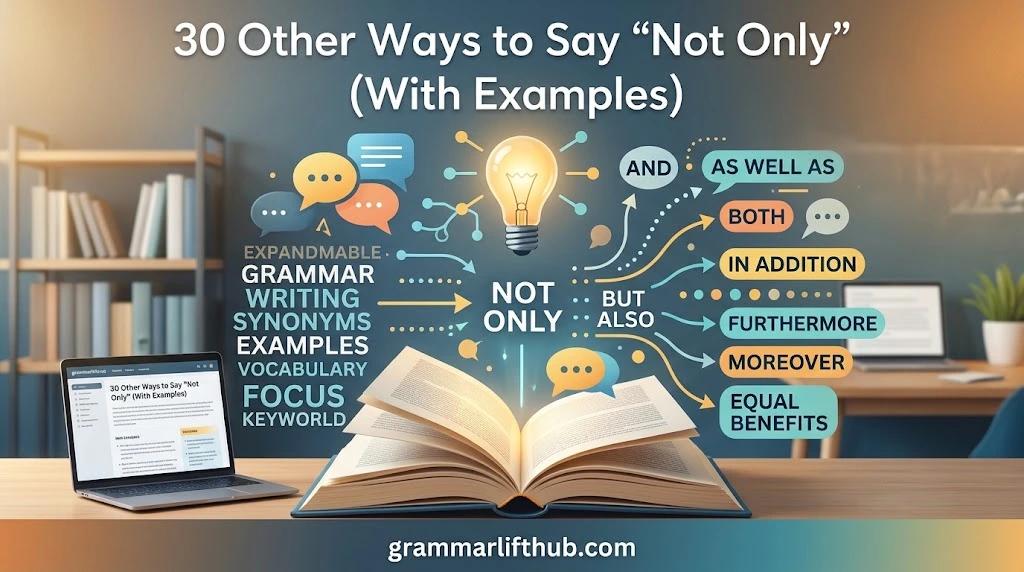
There are many useful ways to say “not only” without repeating the same structure every time. Some alternatives sound formal and professional, while others feel casual, emotional, persuasive, or reflective. The right choice depends on your audience, your purpose, and the tone you want to create.
The phrase “not only” is a powerful connector in English. It helps you build emphasis, add information, and create strong parallel structure in both writing and speech. Whether you are writing an essay, a business email, a speech, or a blog post, using different ways to say not only can make your language sound smoother and more natural.
In everyday English, many writers look for alternatives to not only to avoid repetition and improve flow. Some options sound formal, some feel casual, and others work better in professional, political, romantic, or even spiritual contexts. Below, the 30 alternatives are divided into 3 sections of 10 synonyms each so the article stays easy to read and organized.
Did You Know?
The structure “not only … but also” is one of the most common emphasis patterns in English. It is used to highlight two related ideas, often making the second idea feel stronger, more surprising, or more important. Because of this, many speakers and writers use it to sound more polished and persuasive.
What Does “Not Only” Mean?
“Not only” is used to introduce one part of a paired idea, usually followed by “but also”. It means something is true in one way and in another way too. It adds emphasis and helps connect two related statements smoothly.
Professional or Political Way to Say “Not Only”
In formal, professional, or political writing, better alternatives include in addition to, furthermore, moreover, as well as, along with, and equally important. These sound more structured, respectful, and suitable for speeches, reports, and public statements.
1. In addition to
Definition: A phrase used to add another fact, idea, or detail to what has already been said.
Meanings: Besides, plus, along with.
Example 1: “In addition to strong grades, she showed leadership.”
Example 2: “In addition to being smart, he is very kind.”
Detailed Explanation:
This is one of the most natural and formal alternatives to not only. It works well when you want to add information without sounding repetitive. It is common in essays, reports, and professional speech because it feels smooth and balanced.
Tone: Formal, clear, polished.
Best use: Academic writing, reports, business communication.
2. Besides
Definition: A word used to add extra information or another reason.
Meanings: In addition, also, apart from that.
Example 1: “Besides being talented, she is very disciplined.”
Example 2: “Besides the cost, time is also a concern.”
Detailed Explanation:
This word is simple and flexible. It can sound casual or slightly formal depending on the sentence. It is useful when you want to include another point naturally without creating a heavy structure.
Tone: Neutral, natural, conversational.
Best use: Everyday speech, essays, practical writing.
3. As well as
Definition: A phrase used to connect two things that both apply.
Meanings: Along with, plus, together with.
Example 1: “She is a writer as well as a teacher.”
Example 2: “He speaks English as well as Urdu.”
Detailed Explanation:
This is a very common and elegant alternative to not only. It is especially useful when you want to mention two qualities, roles, or actions in one sentence. It keeps the sentence light and readable.
Tone: Polished, natural, balanced.
Best use: Formal writing, introductions, descriptions.
4. Along with
Definition: A phrase used to show that something comes together with something else.
Meanings: Together with, in company with, plus.
Example 1: “She came along with her sister.”
Example 2: “The report was sent along with the documents.”
Detailed Explanation:
This phrase is practical and easy to understand. It works well when the second idea is added naturally to the first. It is slightly more descriptive than not only, which makes it useful in both writing and speech.
Tone: Clear, practical, friendly.
Best use: General communication, instructions, explanations.
5. Also
Definition: A word used to add another fact or idea.
Meanings: Too, in addition, likewise.
Example 1: “She is smart and also hardworking.”
Example 2: “The film was funny, and also thoughtful.”
Detailed Explanation:
This is one of the easiest alternatives to use. It is short, direct, and very common in modern English. It does not replace the full structure of not only, but it does help create a similar sense of addition.
Tone: Simple, direct, neutral.
Best use: Everyday writing, casual speech, short statements.
6. Likewise
Definition: A word used to show that something is true in the same way.
Meanings: Similarly, in the same manner, too.
Example 1: “The first speech was inspiring; the second was likewise powerful.”
Example 2: “She is polite, and her brother is likewise respectful.”
Detailed Explanation:
This word sounds polished and slightly formal. It is useful when two ideas match in quality or effect. It works well in writing where you want to sound thoughtful and measured.
Tone: Formal, balanced, refined.
Best use: Essays, speeches, reflective writing.
7. Too
Definition: A short word used to add something similar or additional.
Meanings: Also, as well, in addition.
Example 1: “She is kind and generous too.”
Example 2: “He can sing too.”
Detailed Explanation:
This is one of the most natural words in spoken English. It is very simple and casual, which makes it useful in everyday conversation. It is not a direct substitute for not only, but it often serves a similar function.
Tone: Casual, easy, conversational.
Best use: Speech, informal writing, daily conversation.
8. More than that
Definition: A phrase used to add a stronger or deeper point.
Meanings: Beyond that, even more, additionally.
Example 1: “She is a leader, more than that, she is a mentor.”
Example 2: “It was useful, and more than that, it was life-changing.”
Detailed Explanation:
This phrase is useful when you want to move beyond one idea and introduce a deeper meaning. It creates emphasis and can sound emotional, thoughtful, or persuasive depending on the context.
Tone: Emphatic, reflective, expressive.
Best use: Speeches, storytelling, opinion writing.
9. On top of that
Definition: A phrase used to add another point, often one that strengthens the idea.
Meanings: Besides that, additionally, furthermore.
Example 1: “He is talented, and on top of that, he is humble.”
Example 2: “The plan was affordable, and on top of that, it was simple.”
Detailed Explanation:
This phrase sounds conversational and lively. It is often used in spoken English when you want to build momentum in your sentence. It can add a friendly, natural tone to your writing or speech.
Tone: Casual, energetic, expressive.
Best use: Conversation, blogs, informal persuasion.
10. Not to mention
Definition: A phrase used to add an extra point that strengthens the main idea.
Meanings: Let alone, in addition, and even more.
Example 1: “The hotel was clean, not to mention affordable.”
Example 2: “She is skilled, not to mention highly reliable.”
Detailed Explanation:
This phrase is especially useful when the second idea makes the first one even stronger. It adds style and emphasis, which makes it great for persuasive writing. It can feel formal, casual, or literary depending on the sentence.
Tone: Emphatic, persuasive, flexible.
Best use: Marketing, essays, reviews.
11. Furthermore
Definition: A formal word used to add another important point.
Meanings: In addition, moreover, additionally.
Example 1: “The proposal is practical. Furthermore, it is affordable.”
Example 2: “He was honest. Furthermore, he was respectful.”
Detailed Explanation:
This is a strong formal connector used in academic, legal, and professional writing. It helps move the argument forward in a clean and logical way. It often sounds more serious than not only.
Tone: Formal, serious, logical.
Best use: Essays, reports, speeches.
12. Moreover
Definition: A word used to introduce another related and important fact.
Meanings: Besides, furthermore, in addition.
Example 1: “The plan was effective. Moreover, it was easy to follow.”
Example 2: “She is talented. Moreover, she is dependable.”
Detailed Explanation:
This is one of the best alternatives for polished writing. It adds weight to the sentence and sounds confident. It is often used in professional communication and structured arguments.
Tone: Formal, strong, refined.
Best use: Academic writing, editorial content, reports.
13. In fact
Definition: A phrase used to strengthen or confirm a statement.
Meanings: Actually, indeed, as a matter of fact.
Example 1: “He was tired. In fact, he had not slept all night.”
Example 2: “She is skilled. In fact, she is one of the best.”
Detailed Explanation:
This phrase helps sharpen your point and makes the second idea feel more exact or surprising. It is useful when you want to emphasize reality rather than simple addition.
Tone: Confident, clear, assertive.
Best use: Explanations, arguments, clarifications.
14. Indeed
Definition: A word used to emphasize a statement or confirm something strongly.
Meanings: Truly, certainly, certainly so.
Example 1: “He is talented, indeed remarkable.”
Example 2: “The result was, indeed, impressive.”
Detailed Explanation:
This word adds elegance and emphasis. It works well in formal writing, speeches, and literary-style English. It feels more elevated than everyday words like also or too.
Tone: Formal, elegant, emphatic.
Best use: Speeches, essays, polished writing.
Read More: 30 Other Ways to Say “Save the Date” (With Examples)
15. Equally important
Definition: A phrase used to show that another point has the same value or weight.
Meanings: Just as important, same level, equally significant.
Example 1: “The cost matters; equally important, so does quality.”
Example 2: “She is creative and, equally important, dependable.”
Detailed Explanation:
This is a strong professional alternative that works well when two ideas deserve equal attention. It is especially useful in arguments, presentations, and formal writing.
Tone: Balanced, formal, thoughtful.
Best use: Business, policy, academic discussion.
16. In the same way
Definition: A phrase used to show similarity between two ideas.
Meanings: Similarly, likewise, likewise so.
Example 1: “The first group improved quickly. In the same way, the second group adapted well.”
Example 2: “He leads with patience; in the same way, she guides with kindness.”
Detailed Explanation:
This phrase is useful when you want to compare two ideas calmly and clearly. It is not a perfect replacement for not only, but it works well when the sentence needs a matching structure.
Tone: Clear, thoughtful, measured.
Best use: Academic, analytical, explanatory writing.
17. Besides that
Definition: A phrase used to add another piece of information.
Meanings: Also, in addition, apart from that.
Example 1: “The food was great. Besides that, the service was excellent.”
Example 2: “She is experienced. Besides that, she is very adaptable.”
Detailed Explanation:
This is a casual and flexible phrase that works well in speech and writing. It keeps the sentence flowing and helps you introduce another point naturally.
Tone: Casual, conversational, easy.
Best use: Blogs, speaking, everyday communication.
18. Plus
Definition: A short word used to add something extra.
Meanings: Also, additionally, along with.
Example 1: “The room was clean, plus it had a great view.”
Example 2: “He is friendly, plus very reliable.”
Detailed Explanation:
This is a modern and casual connector. It is often used in speaking and informal writing. It gives your sentence a relaxed, quick rhythm that feels natural.
Tone: Casual, modern, light.
Best use: Informal writing, blogs, conversations.
19. Beyond that
Definition: A phrase used to introduce an additional or stronger point.
Meanings: More than that, further, in addition.
Example 1: “She was skilled. Beyond that, she was inspiring.”
Example 2: “The idea was useful. Beyond that, it was transformative.”
Detailed Explanation:
This phrase works well when the added point is more powerful than the first. It adds depth and can feel emotional, thoughtful, or persuasive depending on the context.
Tone: Reflective, expressive, strong.
Best use: Storytelling, speeches, commentary.
20. Not just
Definition: A phrase used to show that something is more than one thing.
Meanings: Not merely, not simply, more than.
Example 1: “She is not just intelligent, but also kind.”
Example 2: “This is not just a book, but a guide.”
Detailed Explanation:
This is one of the closest alternatives to not only. It helps create emphasis and contrast in a smooth way. It is widely used in both casual and formal contexts because it sounds natural and strong.
Tone: Emphatic, flexible, clear.
Best use: Writing, speeches, persuasion.
21. Add to that
Definition: A phrase used to introduce an extra point that strengthens the sentence.
Meanings: Also, in addition, furthermore.
Example 1: “He is disciplined. Add to that, he is highly creative.”
Example 2: “The product is useful. Add to that, it is affordable.”
Detailed Explanation:
This phrase is conversational and expressive. It feels like you are building your idea step by step. It works especially well in blogs, discussions, and spoken English where a natural flow matters.
Tone: Casual, flowing, persuasive.
Best use: Blog writing, speech, discussion.
22. What is more
Definition: A formal phrase used to introduce an additional important point.
Meanings: Furthermore, moreover, additionally.
Example 1: “The team was prepared. What is more, it was motivated.”
Example 2: “The course was practical. What is more, it was affordable.”
Detailed Explanation:
This is a refined and somewhat old-fashioned phrase that still sounds elegant in formal writing. It adds weight to your statement and works well in speeches, editorials, and polished essays.
Tone: Formal, elegant, literary.
Best use: Essays, speeches, formal commentary.
23. Alongside
Definition: A word used to show something happens together with something else.
Meanings: With, together with, next to.
Example 1: “She worked alongside experienced professionals.”
Example 2: “The policy was introduced alongside new reforms.”
Detailed Explanation:
This word is useful when two ideas, actions, or things exist together. It has a professional and neat feel, making it suitable for reports and formal descriptions.
Tone: Formal, clean, structured.
Best use: Business, official writing, reports.
24. Coupled with
Definition: A phrase used to show two things are combined or connected.
Meanings: Together with, combined with, along with.
Example 1: “Hard work, coupled with patience, leads to success.”
Example 2: “Strong leadership, coupled with honesty, builds trust.”
Detailed Explanation:
This is a very polished phrase that is often used in professional and academic writing. It gives the sentence a formal structure and helps show the relationship between two important ideas.
Tone: Formal, intelligent, balanced.
Best use: Academic papers, reports, analysis.
25. In tandem with
Definition: A phrase used to show that two things happen together or in coordination.
Meanings: Together with, alongside, in coordination with.
Example 1: “The project was completed in tandem with the design team.”
Example 2: “The policy worked in tandem with public support.”
Detailed Explanation:
This phrase sounds advanced and professional. It is especially useful in business, technical, or strategic contexts where cooperation or parallel action is important.
Tone: Formal, professional, strategic.
Best use: Business, policy, coordination contexts.
26. Along with that
Definition: A phrase used to add another related point.
Meanings: Besides that, in addition, also.
Example 1: “She is experienced. Along with that, she is very organized.”
Example 2: “The event was successful. Along with that, it was inspiring.”
Detailed Explanation:
This phrase is easy to use and sounds natural in conversation. It helps you add another idea without sounding stiff. It works well when you want to keep a friendly rhythm in your sentence.
Tone: Natural, conversational, smooth.
Best use: Blogs, conversations, casual explanation.
27. More than simply
Definition: A phrase used to show that something has a deeper or broader meaning.
Meanings: Not merely, beyond, greater than just.
Example 1: “She was more than simply a manager; she was a mentor.”
Example 2: “It was more than simply a speech; it was a call to action.”
Detailed Explanation:
This phrase is useful when you want to create emotional depth or highlight significance. It works beautifully in reflective, persuasive, or literary writing.
Tone: Reflective, emotional, thoughtful.
Best use: Essays, speeches, storytelling.
28. Not just … but also
Definition: A contrast-and-addition structure used to show two important qualities.
Meanings: More than, both, additionally.
Example 1: “She is not just smart, but also compassionate.”
Example 2: “The movie is not just entertaining, but also meaningful.”
Detailed Explanation:
This is one of the strongest and most natural alternatives to not only. It is clear, expressive, and very common in both speech and writing. It adds rhythm and emphasis without sounding unnatural.
Tone: Strong, balanced, expressive.
Best use: General writing, speaking, persuasive language.
29. No less than
Definition: A phrase used to emphasize that something is significant or surprising.
Meanings: At least, even, surprisingly.
Example 1: “She was no less than brilliant.”
Example 2: “The response was no less than extraordinary.”
Detailed Explanation:
This phrase adds dramatic emphasis. It is best used when you want the reader to feel the importance of the statement. It can sound literary, formal, or emotionally powerful.
Tone: Dramatic, formal, emphatic.
Best use: Writing with impact, speeches, literature.
30. Not only that
Definition: A phrase used to introduce an additional strong point.
Meanings: Furthermore, in addition, even more.
Example 1: “She is talented. Not only that, she is also generous.”
Example 2: “The service was fast. Not only that, it was friendly.”
Detailed Explanation:
This phrase is very natural and effective in modern English. It helps you build momentum and add emphasis smoothly. It is one of the easiest alternatives to use in everyday speaking and writing.
Tone: Natural, emphatic, engaging.
Best use: Blogs, conversation, persuasive writing.
FAQs
1. What is the most common alternative to “not only”?
Not just … but also, in addition to, and as well as are among the most common alternatives, depending on the sentence.
2. Which alternative sounds most formal?
Moreover, furthermore, coupled with, and equally important sound the most formal and professional.
3. Can I use these alternatives in academic writing?
Yes. Phrases like in addition to, moreover, furthermore, and equally important are especially suitable for academic writing.
4. What is the most natural casual alternative?
Also, besides, plus, and not just sound the most natural in everyday conversation.
5. Can “not only” be replaced in every sentence?
No. Some alternatives work better than others depending on sentence structure. The best choice depends on whether you need formality, emphasis, or a casual tone.
Conclusion
There are many useful ways to say “not only” without repeating the same structure every time. Some alternatives sound formal and professional, while others feel casual, emotional, persuasive, or reflective. The right choice depends on your audience, your purpose, and the tone you want to create.
Using these alternatives can make your writing smoother, richer, and more engaging. Whether you are writing an essay, a speech, a blog post, or a message, these expressions help you add depth, balance, and style to your English.



1 thought on “30 Other Ways to Say “Not Only” (With Examples)”