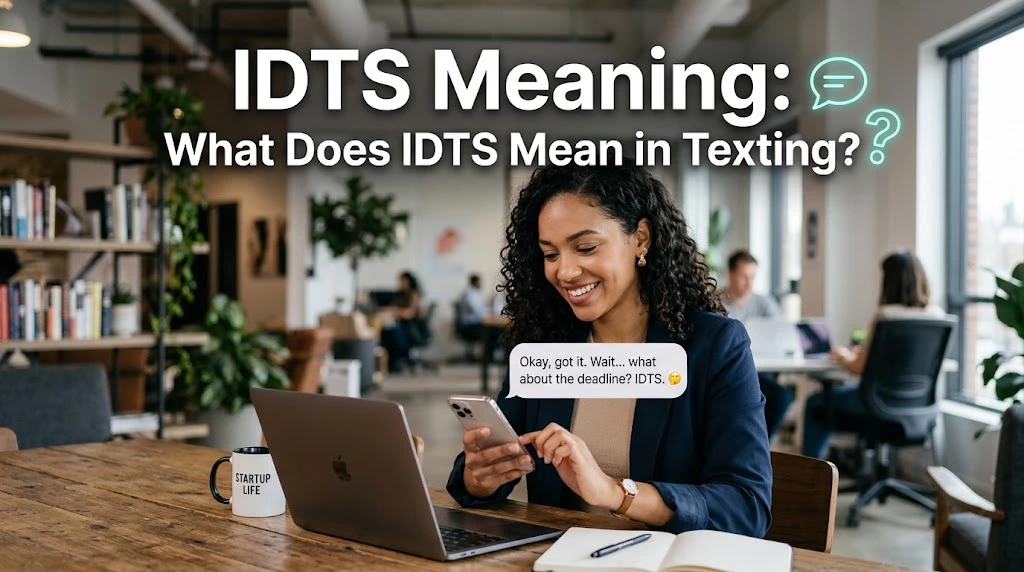
IDTS meaning in texting is “I Don’t Think So.” People commonly use this abbreviation in text messages, social media comments, and online chats to express doubt, disagreement, or a negative opinion. Instead of typing the complete phrase, they write IDTS to keep conversations short and casual. For example, if someone asks, “Do you think he will come today?” you can reply, “IDTS,” meaning you don’t think he will come.
The IDTS abbreviation is popular in informal digital communication because it’s quick and easy to understand. You may see it on Snapchat, TikTok, Instagram, WhatsApp, and other messaging platforms. Depending on the conversation, IDTS can sound neutral, playful, or slightly dismissive. Its meaning usually stays the same, but the tone can change based on the situation and your relationship with the sender.
Understanding what IDTS means in a text can help you interpret messages correctly and respond naturally. It’s also useful to know the difference between IDTS and similar texting abbreviations, such as IDK (I Don’t Know) and IDT (I Don’t Think). In this guide, you’ll learn the full form of IDTS, its meaning in different conversations, practical examples, and simple ways to reply when someone sends you this abbreviation.
Quick Answer
IDTS stands for “I Don’t Think So.” It’s a common informal abbreviation used in texting and online chats to express doubt, disagreement, or a negative prediction. Its exact tone depends on the context and the relationship between the people talking.
TL;DR
- Full form: I Don’t Think So.
- Main meaning: Expressing doubt or disagreement.
- Where it’s used: Text messages, Snapchat, TikTok, Instagram, and other online chats.
- Tone: Usually casual, but it can sometimes sound dismissive.
- Example: “IDTS he’ll come tonight” means “I don’t think he’ll come tonight.”
- Similar abbreviation: IDK means “I Don’t Know,” while IDTS expresses an opinion or expectation.
What Does IDTS Stand For?
IDTS stands for I Don’t Think So, a phrase people use when they believe something is unlikely or disagree with an idea.
The abbreviation uses the first letters of the words in the phrase:
| Letter | Word |
|---|---|
| I | I |
| D | Don’t |
| T | Think |
| S | So |
Rather than typing the complete expression, someone can use IDTS in a quick reply. It’s especially useful when friends are making plans, discussing possibilities, or sharing opinions through messages.
For example:
- “Will the store still be open?” — “IDTS.”
- “Do you think she knows?” — “IDTS.”
- “Are we going out tonight?” — “IDTS, the weather looks bad.”
In each case, the speaker thinks the answer is probably no. However, IDTS doesn’t always mean the person is completely certain. The phrase often communicates a personal judgment rather than a proven fact.
What Does IDTS Mean in Texting?
In everyday texting, IDTS is a quick way to respond when you don’t expect something to happen or don’t agree with what someone says. It often works like “probably not,” “I doubt it,” or “I don’t believe so.”
The abbreviation is informal, so it fits naturally into conversations with friends, family members, and people you know well.
Examples of IDTS in Text Messages
Here are some realistic examples showing how IDTS works in different situations.
Example 1: Making plans
- Friend: “Are we going to the beach tomorrow?”
- You: “IDTS. The weather looks terrible.”
Meaning: You don’t think the trip will happen because of the weather.
Example 2: Asking about someone
- Friend: “Do you think Alex likes me?”
- You: “IDTS, but I could be wrong.”
Meaning: You don’t believe Alex likes your friend, although you’re not completely certain.
Example 3: Discussing school or work
- Coworker: “Will we finish everything before five?”
- You: “IDTS. We still have three tasks left.”
Meaning: You don’t expect the work to be completed by five.
Example 4: Casual conversation
- Friend: “Is that movie worth watching?”
- You: “IDTS. The reviews don’t look great.”
Meaning: You doubt that the movie is worth watching.
These examples show that IDTS usually communicates an opinion or expectation, not a guaranteed fact.
What Does IDTS Mean on Snapchat, TikTok, and Instagram?
IDTS generally keeps the same meaning across social media platforms: “I Don’t Think So.” The main difference is how people use it in each setting.
IDTS on Snapchat
People may use IDTS in private chats or replies to a friend’s Snap. For example, “IDTS, he’s not coming” means the sender doesn’t expect him to show up.
IDTS on TikTok
In comments or direct messages, IDTS can express skepticism about a video, prediction, or opinion. For example, “IDTS that’s how it works” indicates disagreement with a claim.
IDTS on Instagram
Someone might use IDTS in a direct message or comment to give a quick negative opinion. For example, “IDTS, but let’s see” means the person doubts something but remains open to finding out.
The abbreviation doesn’t have a special, universally recognized meaning on any of these platforms. If you’re unsure about a particular message, consider the conversation that came before it.
What Does IDTS Mean From a Guy or a Girl?
When a guy or a girl sends you IDTS, the abbreviation itself doesn’t reveal their feelings, intentions, or relationship status. The meaning depends on what they’re responding to.
When a guy texts IDTS
Suppose you ask a guy, “Do you think we’re meeting this weekend?” and he replies, “IDTS.”
He probably doesn’t expect the meeting to happen. He might have scheduling concerns, lack information, or simply believe the plan won’t work.
When a girl texts IDTS
Imagine you ask a girl, “Do you think he’ll message me again?” and she responds, “IDTS.”
She’s expressing doubt that he’ll message you. That doesn’t automatically mean she’s being rude or trying to discourage you.
Does IDTS mean someone isn’t interested?
Not necessarily. If someone uses IDTS while discussing a date, relationship, or personal matter, it usually expresses their opinion about that specific situation.
Don’t assume it means rejection without considering the full conversation. If the message is unclear, a simple follow-up question can help you understand what the person means.
Read More: OTW Meaning: What Does OTW Mean in Text and Social Media?
Is IDTS Rude, Sarcastic, or Polite?
IDTS isn’t inherently rude. It’s a casual abbreviation, and its tone can change depending on the situation, wording, punctuation, and relationship between the people communicating.
| Tone | Example | Possible interpretation |
|---|---|---|
| Neutral | “IDTS. We haven’t checked yet.” | The person doubts something. |
| Polite | “IDTS, but I could be wrong.” | The person disagrees without claiming certainty. |
| Sarcastic | “IDTS, genius.” | The person may be mocking someone. |
| Dismissive | “IDTS.” | A short reply that may feel abrupt. |
| Playful | “IDTS lol.” | A casual or joking disagreement. |
These are possible interpretations, not fixed rules. For example, a one-word response might feel perfectly normal between close friends but seem cold in a serious conversation.
If you want to disagree without sounding harsh, explain your reasoning. Saying “IDTS because the store closes early” gives the other person more context than simply replying “IDTS.”
How Do You Reply to IDTS?
Your reply should depend on the original question and whether you agree with the other person’s opinion. You don’t need to use another abbreviation just because someone else did.
Here are some natural responses.
| Situation | Possible reply |
|---|---|
| You agree with their doubt | “Yeah, probably not.” |
| You want an explanation | “Why do you think so?” |
| You disagree | “Really? I think it might happen.” |
| You want to check the facts | “Let’s find out first.” |
| You’re joking with a friend | “We’ll see about that!” |
| You need a clear answer | “So, is that a no?” |
Example conversation
Friend: “Do you think we’ll get tickets?”
You: “IDTS. They’re almost sold out.”
Friend: “Let’s check anyway.”
This conversation shows that IDTS doesn’t have to end a discussion. It can simply introduce doubt, leaving room for more information or another opinion.
IDTS vs. IDK, IDT, and IMO
IDTS looks similar to other texting abbreviations, but each one communicates something slightly different. Knowing the difference helps you understand messages more accurately.
| Abbreviation | Full form | Main purpose |
|---|---|---|
| IDTS | I Don’t Think So | Expresses doubt or a likely negative answer |
| IDK | I Don’t Know | Expresses a lack of knowledge |
| IDT | I Don’t Think | Introduces an incomplete or continuing thought |
| IMO | In My Opinion | Introduces a personal opinion |
| TBH | To Be Honest | Introduces an honest or candid statement |
| NGL | Not Gonna Lie | Signals a candid remark |
IDTS vs. IDK
IDTS expresses a judgment, while IDK expresses uncertainty due to not knowing.
For example:
- “Will she attend?” — “IDTS.” The speaker doubts that she will attend.
- “Will she attend?” — “IDK.” The speaker doesn’t know whether she will attend.
These answers aren’t interchangeable because one expresses an expectation and the other expresses a lack of knowledge.
IDTS vs. IDT
IDT means “I Don’t Think,” while IDTS means “I Don’t Think So.” IDT often appears before an additional thought, such as “IDT that’s a good idea.” IDTS can stand alone as a short negative response.
IDTS vs. IMO
IMO means “In My Opinion.” It signals that a statement reflects someone’s personal view. IDTS more specifically communicates doubt or disagreement.
For example, “IMO, this movie is great” shares an opinion, while “IDTS, this movie will win an award” expresses doubt about a prediction.
When Should You Use IDTS?
IDTS works best in informal conversations where the other person understands common texting abbreviations.
Use it when you’re:
- Responding to a question with a likely negative answer.
- Expressing doubt about someone’s prediction.
- Disagreeing with a casual statement.
- Discussing plans that probably won’t happen.
- Replying quickly in a group chat or direct message.
However, avoid relying on IDTS in situations that require clear, professional communication. In a work email, formal discussion, or important conversation, writing “I don’t think so” and explaining why may be more helpful.
For instance, instead of writing “IDTS” to a manager asking whether a deadline is realistic, you could say, “I don’t think we can meet the deadline without additional time.”
The complete phrase makes your meaning clearer and gives the other person a better understanding of your reasoning.
Common Misunderstandings About IDTS
Although IDTS has a straightforward meaning, it’s easy to misinterpret the tone of a short message.
IDTS doesn’t always mean a definite no. The phrase expresses what someone thinks, so the person may be uncertain or open to changing their mind.
IDTS doesn’t automatically indicate anger. A short response can look blunt in writing, but that doesn’t prove the sender is upset.
IDTS doesn’t reveal romantic interest. If someone uses it in a conversation about dating, the abbreviation alone cannot tell you whether they’re interested in you.
IDTS and IDK aren’t the same. IDTS communicates doubt about something, whereas IDK means the person doesn’t know.
IDTS isn’t limited to one social media app. Its common meaning remains the same in ordinary texting, DMs, and online discussions.
When interpreting IDTS, read the complete message instead of focusing on the abbreviation alone.
FAQs About IDTS Meaning
1. What does IDTS mean in texting?
IDTS means “I Don’t Think So.” People use it to express doubt, disagreement, or the belief that something probably won’t happen.
2. What does IDTS mean in slang?
In internet slang, IDTS is a shortened form of “I Don’t Think So.” It is commonly used in casual conversations as a quick way to express a negative opinion or a doubtful response.
3. What does IDTS mean on Snapchat?
On Snapchat, IDTS usually means “I Don’t Think So.” Someone might use it in a chat to say they doubt a plan will work or don’t expect something to happen.
4. Is IDTS the same as IDK?
No. IDTS means “I Don’t Think So,” while IDK means “I Don’t Know.” IDTS expresses a judgment or expectation, whereas IDK indicates that someone doesn’t have the answer.
5. How do you respond when someone says IDTS?
You can agree, ask why they think that, or explain your own opinion. For example, you might reply, “Why not?” or “Let’s check and see.”
6. Can IDTS sound rude?
Yes, it can sound dismissive in some situations, especially when sent as a short reply during a serious conversation. However, it’s not inherently rude; context and tone matter.
Conclusion
The most common IDTS meaning is “I Don’t Think So.” It’s an informal texting abbreviation used to express doubt, disagreement, or the belief that something is unlikely to happen.
You may encounter IDTS in text messages, Snapchat chats, TikTok comments, Instagram DMs, and other online conversations. Although its basic meaning stays consistent, its tone can range from neutral and polite to sarcastic or dismissive.
The best way to understand IDTS is to consider the complete message and the situation in which it appears. When you use it yourself, remember that a few extra words can make your meaning clearer and help prevent misunderstandings.

2 thoughts on “IDTS Meaning: What Does IDTS Mean in Texting?”